
Overview

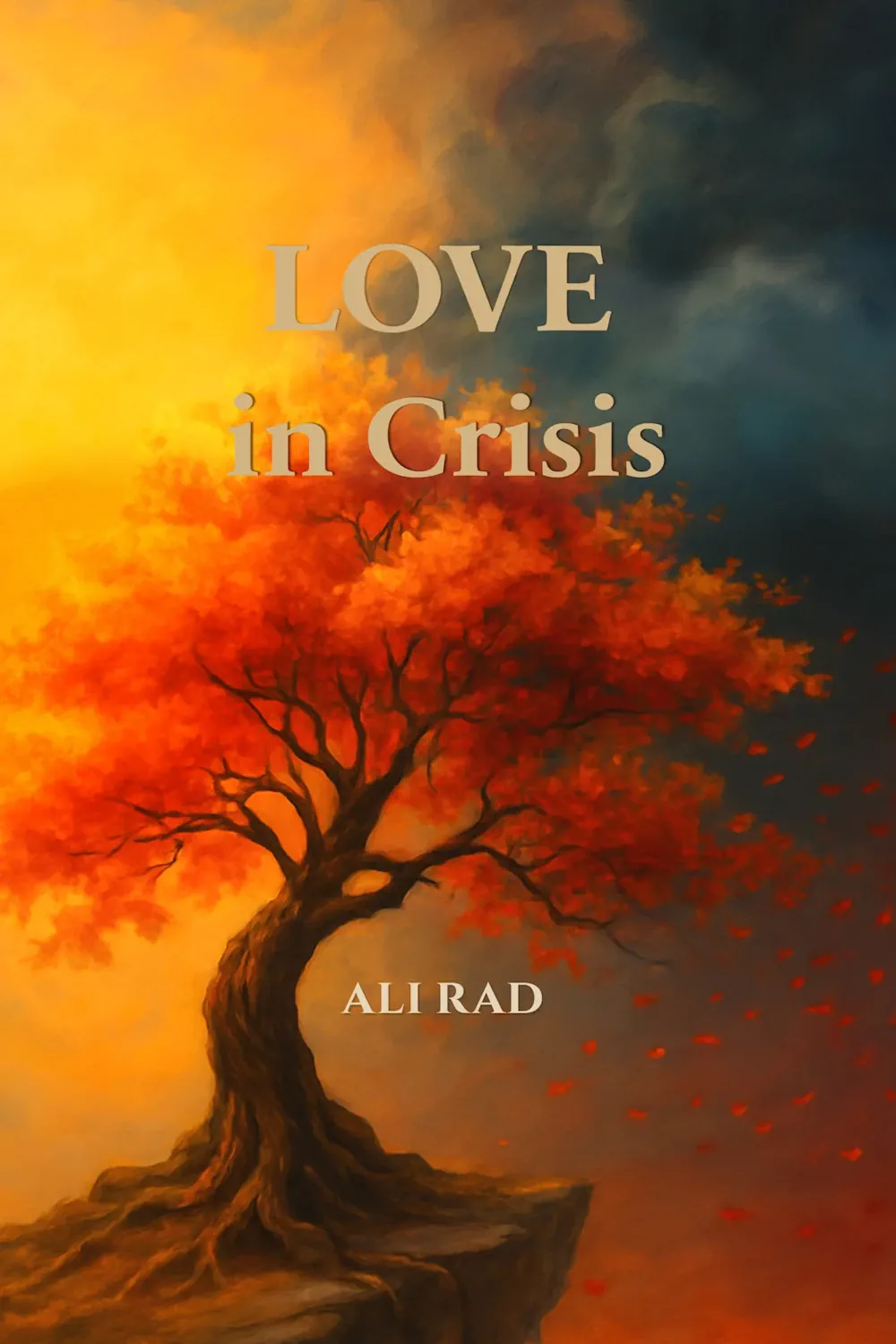
Love in Crisis is a historical–cultural novel by Ali Rad that follows the life of Dr. Abraham Macdonald across eight turbulent decades. The story opens at dawn on Nowruz 2021, during the global COVID-19 pandemic, when an aging New York physician prepares to honor the memory of his lost son. That quiet moment leads him to revisit a past shaped by war, revolution, and personal trials.
The narrative begins with Abraham’s childhood in wartime Chicago and traces his journey from the United States to Iran before and after the revolution. Along the way he encounters love, captivity, political upheaval, and personal crises. One of the defining episodes of his life is his 444-day captivity during the Iran hostage crisis in Tehran, an event that brings him public recognition in the United States.
Alongside the life story of its protagonist, the novel explores hidden connections among history, culture, myth, and story. The author suggests that while human lives begin with the simple tales passed down within loving families, their destinies ultimately unfold within far more complex stories. People take roles in the stories of others, and some become creators of stories themselves.
Analysis

Structurally, Love in Crisis is a multi-layered novel that blends elements of historical fiction, philosophical narrative, and cultural storytelling. The narrative unfolds retrospectively, as the protagonist in his later years looks back on the chain of events that shaped his life—or that he himself helped shape.
Several central themes organize the work:
1. History and individual life
Abraham’s story unfolds amid major historical developments from the twentieth century to the early twenty-first. Coming from a family background shaped by the world wars, he passes through revolutionary crises, the religious revolution in Iran, and major economic and cultural transformations in the West before the narrative reaches the global COVID-19 pandemic.
2. Love, constraint, and liberation
The story moves through profound emotional and familial experiences, raising questions about love, marriage, and raising children.
3. Story as a method of understanding
The novel insists that storytelling is not merely entertainment but a tool for dynamic experience, intellectual cultivation, and for traversing—or exploring anew—the world.
4. Myth and narrative
Mythological elements appear throughout the deeper layers of the story, giving the narrative broader symbolic meaning. The author seeks to shape the well-known Farsi terms “qesseh” (tale) and “dastan” (story) into two distinct yet parallel and mutually reinforcing concepts.
From this perspective, the novel introduces the concept of Storyology, an approach that views storytelling not merely as a literary form but as a system of thought and an educational framework. Within the narrative appears a fictional institution called the Mihr Story Foundation, whose divisions include the Sci-Storic Club, where knowledge and experience are re-expressed through narrative forms.
Reception

Love in Crisis is the author’s debut novel and has drawn the attention of some writers and readers.
Dr. Amir Esmail Sandoozi wrote about the work:
“From the earliest stages of its creation, I witnessed the author’s dedication and meticulous care in selecting words and shaping the structure of the narrative. It is a work rich in content and worthy of attention.”
Readers have highlighted several notable aspects of the novel:
-
the integration of historical events with long-span storytelling
-
a cultural and mythological perspective on human experience
-
the introduction of Storyology as a new approach to understanding narrative
The novel has been published in several formats, including paperback, hardcover, eBook, and audiobook, and is available through major booksellers.