Overview

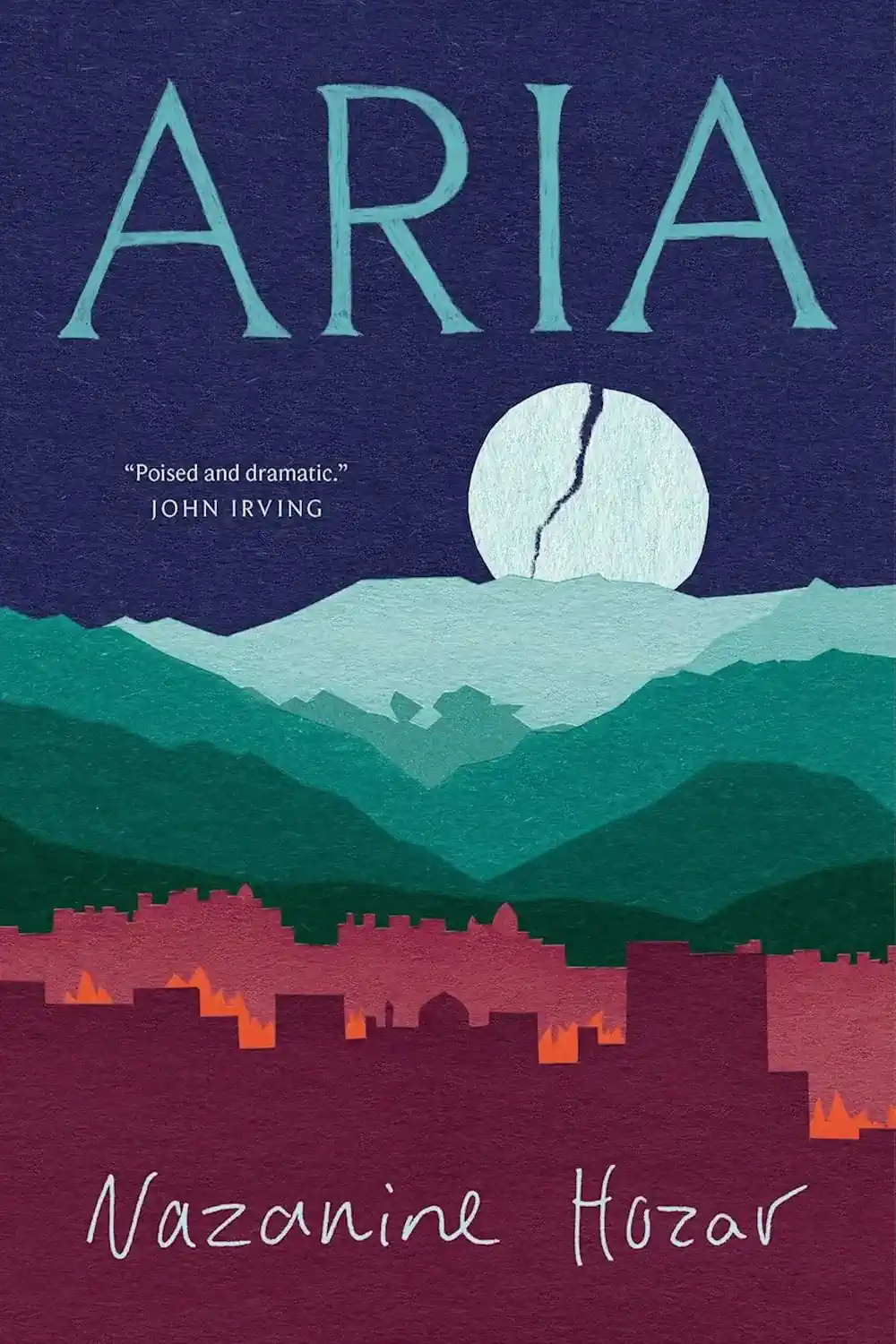
Aria is the debut novel of Iranian-Canadian writer Nazanine Hozar, published in 2019. Set primarily in Tehran, the novel spans several decades of Iranian history leading up to the 1979 Iranian Revolution.
The story begins when an army driver, Behrouz Bakhtiar, discovers a newborn girl abandoned on a snowy street and decides to raise her as his own daughter. He names the child Aria, and her life unfolds across different social worlds of Tehran.
Aria grows up under the influence of three women who shape her identity: Zahra, the harsh wife of Behrouz; Fereshteh, a wealthy woman who later adopts her; and Mehri, a poor and enigmatic woman connected to Aria’s past. Through these relationships the novel traces Aria’s journey from childhood to adulthood against the backdrop of political upheaval.
Tehran itself functions almost as a character in the novel, depicted as a divided city marked by class differences, religious diversity, and social tensions that eventually erupt during the revolution.
Analysis

Structurally, Aria is a bildungsroman, following the protagonist from infancy to young adulthood. The narrative employs shifting perspectives, allowing different characters and social environments to illuminate the broader landscape of Iranian society.
Major thematic elements include:
Identity and belonging
Aria’s life is shaped by questions of origin, family, and social identity as she moves between different households and classes.
Motherhood and female experience
The novel explores womanhood through three contrasting maternal figures, each representing different possibilities and limitations for women in Iranian society.
Class and social divisions
The contrast between wealthy northern Tehran and the poorer southern districts reflects broader inequalities within Iranian society.
Personal lives within political upheaval
The narrative intertwines private relationships with historical events, showing how the Iranian Revolution reshapes the lives of ordinary people.
The city of Tehran provides the central setting and atmosphere of the novel, with vivid depictions of alleyways, courtyards, markets, and neighborhoods that anchor the story in a specific cultural landscape.
Reception

Aria received strong critical attention after its publication in 2019 and quickly became one of the most discussed English-language novels portraying modern Iranian history.
Awards and Nominations
-
Shortlisted for the Ethel Wilson Fiction Prize (2020), a major literary award recognizing the best work of fiction by authors from British Columbia or Yukon.
-
Shortlisted for the Amazon Canada First Novel Award (2020), a national prize honoring the best debut novel by a Canadian author.
The novel also became a Globe and Mail Top-Ten bestseller.
Critical Reception
Prominent writers and critics praised the novel:
-
Margaret Atwood described it as
“a Doctor Zhivago of Iran.” -
John Irving called it
“a feminist odyssey about a girl during the Iranian Revolution.” -
Hisham Matar praised its intimate portrayal of Iranian lives and historical upheaval.
Other critical responses:
-
Publishers Weekly described the novel as an ambitious and sweeping coming-of-age epic set during the Iranian Revolution.
-
Kirkus Reviews called it an impressive and emotionally powerful debut.
-
The Guardian praised its blending of personal drama and political history and its broad narrative scope.
Many reviewers emphasized that the novel succeeds in combining a personal coming-of-age story with a sweeping historical narrative, offering readers a vivid portrait of Tehran and Iranian society before the revolution.