
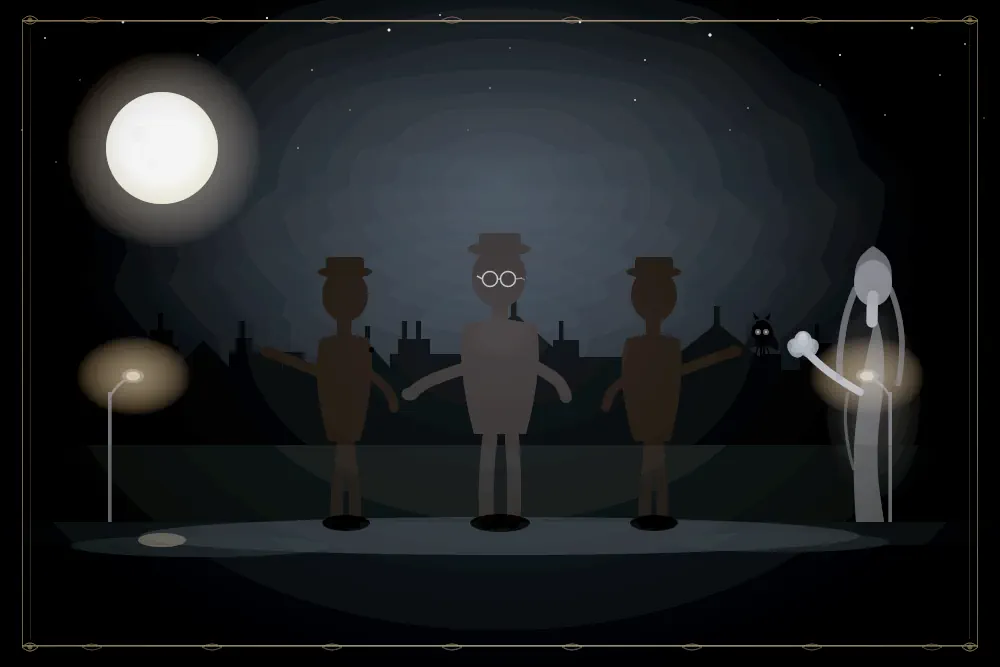
In the overcast, dispiriting dusk, Sadegh Hedayat — the forty-eight-year-old Iranian writer, temporary resident of Paris — is making his way home to the eighteenth arrondissement, Rue Championnet, number 37 bis, when he sees two men waiting outside his building. They ask whether he has come from the police prefecture, and whether he has obtained his residence permit for the next fifteen days. They fall into step beside him through the streets and talk: Going to renew your papers, with a plan like yours! Hedayat says: I have no plan! One of them laughs: Of course you don’t! Suicide? Here in Paris — and in early spring, no less!
In the grey air before nightfall they trail on either side of him, asking what use it is for him to go on living. This life renewed every fifteen days! Don’t they know no hope remains?
Hedayat is nearly silent. One of them reads his thoughts and speaks of his last remaining hope — a miraculous change in everything: You know there is no change coming. At their core, everyone is the same. Your country reeks of oil and beggary, and everyone is in league with the plunderers. Riff-raff — isn’t that the word you use? Riff-raff answer every sincere new idea with a bullet. Just recently a writer was murdered in the Tehran courthouse, in broad daylight, before everyone’s eyes, for the frankness of his thoughts! And the hope that writing might change something — or even just be a mirror — has died inside you. Here no one understands the language of your writing; and those in your country who can read your script — are there more of them than the letters of the alphabet?!
Hedayat wants to know whether they are police. No — the two men look very much like Hedayat himself. Hedayat says that at first glance he mistook them for people he believes are following him. They laugh among themselves.
They go into a café. An ethereal woman brings them coffee and cognac. Hedayat reaches into his pocket: I cannot treat you. They smile: The last remnant of aristocratic hospitality? Hedayat rebuffs this: It is not possible for me! One of them casts a playful glance toward his breast pocket: One can’t say you have nothing! Hedayat pulls back defensively: Not this! The first one presses the joke: Of course — one must think of the future! The second one asks sharply: The cost of burial? Hedayat says: I never learned to beg! The first one laughs: The story of “The Dark Room”! He produces a note and holds it up before his eyes: “I have made a pact with myself that the day my purse runs dry, or I become dependent on someone else, I will put an end to my own life.” He folds the note: Need I say what page and line?
Hedayat, somewhat dazed, peers at them through the half-light that illuminates only the table: You must have a mission. Are you leftists or rightists? Religious or government agents? Someone wrote this bit out and handed it to you. You are only pretending to know a great deal; but in truth you have not read a single word of mine!
Faced with this unexpected outburst, the two exchange a bewildered and uncertain glance for a moment — and then, gradually, one of them begins: “All the people of Shiraz knew that Dash Akol and Kaka Rostam would shoot each other’s shadows…” And as he says it, Dash Akol and Kaka Rostam, daggers drawn in their eternal combat, pass beyond the café window — which has now become, imperceptibly, the very Sardsak quarter of Shiraz — past Marjan with her parrot. Hedayat simply watches. The other turns the lamp on the table toward Hedayat, casting his shadow like an owl upon the wall: “There are wounds in life that consume and erode the soul slowly, in solitude, like a canker…” And as he says it, the ethereal woman — carrying a tray for another customer — drifts for a moment through the café’s half-light, smiling at Hedayat; and a beggar resembling the old junk-peddler, a broken jug under his arm, passes beyond the window — which now faintly resembles a muddy cluster of beaten, flat-roofed houses, with a rattletrap carriage and a skeletal horse visible in the distance. He laughs in a terrifying manner, baring his teeth; midway along his path a fallen woman suddenly steps forward, throws her veil aside, and presses her face and body against the windowpane. Hedayat tries to shake his head and drive them from his mind. One of them describes Alaviyeh Khanom — a stout middle-aged woman who travels endlessly back and forth with pilgrim caravans for both piety and profit, taking temporary husbands along the way; and as he speaks, the caravan and its chanters file past behind him, Alaviyeh Khanom seated among a cart full of other women and children of all sizes, beating her chest and cursing someone ceaselessly. Hedayat watches in silence.
The other says: You don’t want to hear Haji Agha from start to finish. Do you? It would be self-torture! A fixer enthroned on a bench, believing himself the center of the universe! And as he speaks, the café gradually receives a shaft of light through a crack in the ceiling, and Haji Agha is seen seated in the vestibule of his house, imperiously and irritably issuing instructions to several unshaven men; and his voice begins to be heard: “Infiltrate the gatherings; denounce cinema and theatre, spoon and fork, airplanes, automobiles and gramophones. Do not neglect the miracles of the water-shrine!” Then, as if his gaze suddenly falls on Hedayat, he shifts his tone: “My friend, I have lost faith in these young men who go to the West. When they come back they are foreigners.” Haji Agha’s petitioners fade away and only the two most trusted pull close. Haji Agha points at Hedayat, furious: “My friend, this one is dangerous. He is certainly a Bolshevik — estranged from property and weary of life. He must be put underwater.” Suddenly a Parabellum pistol appears from beneath his robes, aimed at them: “In truth you will earn the reward of holy war against the infidels!”
Hedayat involuntarily exclaims: I wish one could destroy them all…! The first shadow steps out of the darkness: No — you cannot tear them apart. For years now they have been beyond your control. They have surrounded you.
No! Who was that who passed just now?
The second shadow emerges from the darkness: Zarinkolah — a woman who lost her husband.
The first shadow asks: Did you love her?
Hedayat smiles.
The second shadow says: She is still searching for her husband. And as he says it, Zarinkolah passes through, looking for her man. The first shadow opens a book: “Love is like a distant song — a haunting, bewitching melody sung by someone ugly and ill-favored. One should not follow it and look upon it face to face.” He closes the book: Do you want to see? It is your own writing — “Afaringan”!
Hedayat, flushed, jumps involuntarily to his feet. The first follows after him: One-sided love. Yes? For a people you love who do not know their own worth! Hedayat bursts out the door; the second follows: Your pain began the day the ethereal woman died in your arms. Your misfortune was that before she died you saw that deep pain in her eyes. Was this not your homeland? Hedayat turns to say something but his tongue is locked. Behind the café glass, the ethereal woman raises a finger to her lips and hushes him with a pale smile — then Hedayat drops his gaze.
They walk through the streets. A hastily bearded man rushes past — bumping into him and pausing — and asks: Are you Iranian? I am looking for a man condemned to death named Hedayat — Sadegh Hedayat! Hedayat says: No — I am Hadi Sedaghat. The man, out of breath, says: I have the warrant for his blood, but I don’t know his face. A curse on the homeland’s postal service! It was sent from Tehran long ago and is still on its way. What does this wretch look like? Hedayat says: He has no portrait — for a long time he has resembled no one; neither his compatriots, nor the people here. The man hurries off, and Hedayat says to his shadows: He is one of them. They have been after me for some time. After the manuscript of Fi Bilad al-Afranji was passed from hand to hand, they obtained an order for my execution. They take their orders from Haji Agha.
The shadows recognize the text — the story of several moralists who come to reform the West and are themselves corrupted by its depravities. And as they speak, the characters from Fi Bilad al-Afranji pass drunk and ruined from either side of Hedayat — one singing and dancing, another arm-in-arm with a harlot.
Hedayat and his two companions go to Père Lachaise. They see a grave being tended by the old junk-peddler. Beside his ramshackle carriage and skeletal horse, the shadows say: Look — even the grave is ready. Two hurried officials climb out of the grave and come straight at Hedayat, asking: Haji Agha wants to know the best manner of death — poison, knife, bullet or rope? He must choose! Hedayat turns and looks at his companions. They shrug, offering no recommendation. He turns back toward the two officials — but they are gone. Bewildered, he turns toward his two companions — and between their shoulders, at the foot of a cypress by a stream, he sees the ethereal woman offering a lotus flower to the old junk-peddler. Hedayat tries to shake this vision from his mind, but when he comes to himself his two companions are gone as well.
Hedayat passes a circus poster, a Ferris wheel, a lottery advertisement, and a row of street painters. One painter invites him to have his portrait done. Hedayat shakes his head and walks on. Moving through the crowd, one of his shadows calls from a distance: “I regret I did not become a painter. It was the only thing I loved and enjoyed!” — Your words, from the protagonist of* “Buried Alive.” * Do you still stand by them? After all that painting with words?* Hedayat turns — and passes a two-windowed optician shop with an owl-in-spectacles as its sign, and beyond it a large bookshop with a photograph of Kafka in its window. From among the passing crowd one shadow says: Strange that you didn’t stop at the bookshop! And the other replies: What good, when you have no money to buy? The first adds: And even if you did — first, his eyeglass frame!
A newsboy cries and circles and several readers step forward. Hedayat passes through them. The first shadow jokes, scanning the papers: Not a word about Iran! — and what if there were? Go on — guess! The other says: Lately some intellectuals have died. Hedayat, walking on, mutters under his breath: In my country no intellectual ever dies — they are all annihilated.
Torrential rain. Umbrellas open. Hedayat walks through the crowd beneath bare, leafless trees. In the distance, on cinema marquees: Hamlet, Night Visitors, The Trial, Rome Open City, Orpheus, The Damned, Shakes the Earth, Citizen Kane, The City — and then an image of the atomic explosion over Hiroshima. But Hedayat goes to the cinema across the way. A shadow says: There are more cheerful films — why these post-WWI ones? We are in the post-WWII era! And the other: They suit your spirit. Don’t they? Your conception of your homeland’s ruin! Hedayat turns to curse them, but there is only the movement of people under umbrellas, and a raincoat-clad policeman watching him from a distance.
Hedayat goes into a dim cinema with four small halls. A door opens: on screen, a yellow-clad wizard consulting the air spirit suddenly realizes his castle is ablaze, and his clay servant — the Golem — walks through the flames. The villagers rejoice at the sight of the burning castle. Hedayat looks at his ticket in the doorway and hears a voice behind him: That is what Gojastedej would have been, if there had been cinema in that country. No? Hedayat looks around in confusion — and knows he cannot be free of his two companions, even when they are not visibly before him. A door opens: on screen, the slaves of the advanced city of Metropolis operate the factories and are monitored by eyes and sophisticated machines. A whisper in Hedayat’s ear: Room for a mustachioed strongman with bulging eyes — in his military boots. Don’t you think? Hedayat turns. A door opens: Nosferatu’s carriage stops and he rises on his tiptoes, hunched, arms extended before him, ascending the stairs. Hedayat shuts the hall’s door. Another door opens: the Phantom Carriage rumbles wearily past. Hedayat settles into his seat. He hears the two murmuring behind him: This corruption and bitterness is in harmony with your wounded spirit — powerless humans, enslaved to themselves or others. Am I right? Hedayat turns angrily — and sees the ethereal woman walking toward him. He starts and his spectacles slide down his nose. Fumbling, he resettles the broken-framed glasses on his face — but now it is a streetwalker, two or three rows beyond, who grins at him brazenly and reaches for the buttons of her dress. Hedayat rises in the middle of the film and leaves.
In the crowded street, two officials run forward from a distance, and only when they bump into him unawares do they pause and say with satisfaction that someone has seen Hedayat on this very street — they will find him soon and finish him off. Hedayat congratulates them, and they hurry away; at the same moment his two companions step forward and look at him as if awaiting a decision. Hedayat suddenly makes a face — raises his eyebrows, draws a half-smile across his face, extends his right hand higher and his left hand lower and open — and balanced on his left tiptoe, extends his right foot forward as if mounting a step: he is imitating Nosferatu. The first shadow says: You are imitating Nosferatu. The dead man who sleeps in his coffin by day and by night seeks warmth and the blood of life. Why? And the second says sharply: You congratulated them. How can you conceal what you feel inside?
Hedayat turns and strides away; they follow. The first rushes: “Perhaps there is only one thing in the world I can do — I ought to have been a theatrical actor.” And the other snaps his fingers in the air: From “Buried Alive”! Under the rain Hedayat quickens his pace to put distance between them, but suddenly he finds the two before him. First shadow: You are saying goodbye! Am I wrong? Everywhere a memory belongs to you, you circle back! Second shadow: Everything has changed — rapidly — and is no longer what the memory held!
Hedayat passes between the two and takes shelter under an awning. The two press in on either side beneath it. Under umbrellas, people pass — fat, thin, content, sorrowful, hurrying, slow. An old man affecting youth; a man who has made himself like a woman; a woman who has dressed herself like a man; one who seems depressed walking with a child the image of himself.
The voice of the first shadow, reading from a page: “Each person carries several faces. Some use only one of these faces constantly — it grows grimy and wrinkled. Another group saves their faces for their offspring. Others change their faces constantly, but once they come of age, they realize that last mask was their final one, and it will soon wear away and crumble, revealing their true face from behind.” You wrote this — do you remember? The Blind Owl!
Hedayat suddenly turns and sees himself in the window of a shop filled with warped mirrors — stretched long, elongated, diminished, enlarged. The voice of the second shadow winds in his ear, reading: “My face had the capacity for what grotesque and terrifying expressions. It was as though all the ridiculous, dreadful and unbelievable forms hidden within me were revealed. All these expressions belonged to me and were mine — terrifying, criminal, and laughable masks that changed at a signal.” — The same Blind Owl, six pages later!
Hedayat removes his rain-wet spectacles and wipes them against his shirt. The rain stops; umbrellas close. Bicycles and handcarts set off. The moon gleams in a puddle. Hedayat approaches and stares into it. His two companions see him and smile: Quite right — the moon has risen over Tehran too. There too, people are looking at the moon. Some with anguish and tears, some indifferent. The second steps forward: It is the sighing of humanity that has clouded the moon’s face. No?
Hedayat says: How long do you intend to read my thoughts?
The first shadow gazes at a cloud passing over the moon: This chiaroscuro reminds you of those films — when the vampire walked. For all their darkness, in those films it is love that ultimately prevails, though in practice it is death that wins. The weary death! There was hope there — a struggle between love and death. Why is there no love that helps in your writing?
Hedayat kicks the moon’s reflection in the puddle, scattering it: The atomic explosion was no April Fool’s joke!
The two are stunned. As if struck by a discovery, they stand rooted, staring after the fleeing Hedayat: Hmm — until now you despaired of your homeland; now you despair of the whole world!
Hedayat walks on quickly and involuntarily; the two rush to catch up: But that was no answer — that was flight from an answer. Why is there no hope for Dash Akol in your writing? Why does Marjan make no effort? Why does love always bring heartbreak?
Hedayat stops — and becomes mysterious; turning toward them with a secretive smile, he lowers his voice: There is a secret you do not know, even if you have memorized every word I wrote. The two lean in with curiosity. Hedayat nearly whispers: Marjan belongs to Haji Agha — she is his fifth wife! The two look at him, stunned and disbelieving. Hedayat: I tell only you. You heard correctly — wife of the vampire! She herself discovers it too late — like a parrot in a cage. If you have not understood this, you have read nothing of mine! Hedayat walks away and they stand baffled, dazed and confounded. Each pulls a book from his pocket, frantically leafing through, searching for this theme. They growl and rage that they never found this point before.
Hedayat crosses the street past a cinema showing The Battle of the Rails and leaves behind a pedestrian crossing. Some people with collection boxes, shaking them, are gathering donations for victims of the Resistance. Hedayat passes through them. An ambulance wails past, and a crowd carrying lit candles moves slowly across the width of the street, bearing banners. In the front rows some are in wheelchairs, some on crutches — missing a hand or a foot.
On the river bridge Hedayat gets out and stares down at the current. The moon’s wavering reflection in the water. His two companions appear behind him: A fall into the water? No — you tried that once. The second confirms: You will not jump into the water. No! You are afraid that panic might seize you and you’d call for help. The first completes the thought: You would be too ashamed to ask anyone for help! Hedayat walks on; they follow. The first says: You have a plan! Hedayat keeps walking, and the second speaks for him: “I have an aversion to things that are planned in advance.” The first dismisses it: That is only a sentence in “Buried Alive” — it may have been revised by now. And turning to walk backward, face to face with Hedayat: Hmm — you truly are saying goodbye; to everything and everywhere!
Hedayat stops. The first says: Why did you not take us to your apartment? Were you afraid we might see the cotton wool? The second doesn’t wait: For three days you’ve been buying cotton wool. Yes? For the cracks! The first continues: You could have gone to the cotton seller and not paid. Hedayat says: I did not pay — I went to the cotton seller. The two look at each other: Well, if it has come to this, then it is the best way; only take care — you must not strike a match! Hedayat smiles: I have no plan.
The two stare, baffled. Hedayat removes his spectacles and looks upward — at the moon, as a cloud passes over it. The first says, astonished, still pressing: I do not take it back. This last look — you truly are saying goodbye! The second gazes at the moon and opens his lips: “The ancestors of all humanity looked up at it; wept before it; and the moon rose, cold and indifferent, and set. It is as though their legacy has remained within it.” Hedayat, replacing his spectacles, gets in first: “Buried Alive” — I don’t know what page! And he walks on. They follow: Do you still think “the moon — solitary and reclusive from on high — awaits the death of the earth with its cold smile, and gazes with a sorrowful face on the foul deeds of the earth’s people”? Hedayat growls: What else does the moon see in Hiroshima — though one night or day its gaze also fell on the misery of Alaviyeh Khanom’s caravan; and forgive me, I do not know what page and line!
In the crowd on the pavement, a blindfolded conjurer who identifies passersby — a small crowd gathered around him — suddenly catches Hedayat’s sleeve and pulls him close; and Hedayat only tries to keep his broken-framed spectacles on his nose. The blindfolded man theatrically searches his mind for the man’s characteristics: Hah — you are not from here! Occupation? None! Perhaps — an artist! Words! Yes — words, words, words — perhaps a writer, a traveler? No — you exiled yourself. In the homeland you longed for here; and here you long for home! Suddenly he stops, alarmed: No — no longer! You are making an important decision.
Hedayat looks at the two men waiting for him in the crowd — and growls: I am making no decision whatsoever!
He walks on. The two shadows follow. The first catches up: Rightly said — “No one decides to commit suicide. Suicide is with certain people. It is in their clay, their character, their nature. They cannot escape it. Suicide too is born with some.” — and he asks the other: Isn’t that “Buried Alive”? The second, following, says: That, and not just once — twice!
Hedayat, not yet far enough away, stops and turns back in exasperation and flips a coin in front of the blindfolded man. The blindfolded man says: Did I not say, Monsieur, that within ten counts he would come back — and that he remembers our coin? Those gathered laugh and applaud. The coin is picked up from the ground by the old junk-peddler. Hedayat turns his back and walks away — Dash Akol with a bloody dagger in hand and a wound in his side follows him. Haji Agha comes from the opposite direction, ranting and foul-mouthed, but before he can reach Hedayat the streetwalker takes Haji Agha’s arm and laughing, draws him away. In the street the death-carriage passes; the old junk-peddler invites him to climb up. The ethereal woman at the curb lifts her skirt and bares her thigh to passersby. On a cart, Alaviyeh Khanom passes before the Eiffel Tower, smacking her children of all sizes and cursing heaven and earth. From the opposite direction comes Zarinkolah — the woman who lost her husband — saying that the man she is looking for is him. In the street a stray dog is crushed under a car. People scream and several car horns blare. The two officials in their haste knock into him as his mind wanders elsewhere, and Hedayat’s spectacles fall. They tell him: We’ve found out that Hedayat wears glasses — all these godless intellectuals wear glasses! And they rush off. Hedayat bends down, retrieves his broken-framed spectacles and places them back on his face.
Beside a cabaret, a clown-like man turns cartwheels and shouts to attract passersby. In the entrance to the cabaret, Marjan stands in a cage just her own size — a parrot in hand, her smile full of sorrow — beckoning everyone inside. Hedayat goes to the Café of Death, whose tables are coffins, and where a clown in a priest’s robes preaches and sings a ludicrous, insolent song mocking life and death. Hedayat curls in his chair like a fetus. The first shadow holds up a text and reads: “We are all alone. Life is a prison — but some draw pictures on the prison wall and keep themselves entertained.” The second shadow approaches: Gojastedej! Hedayat raises his head and sees them at his table. The first says: Do you think what you wrote was a picture on the prison wall — something to keep your head occupied? Or a prelude to this present moment? Hedayat lifts his head to understand if he has grasped this correctly. The second leans in: For years you have been practicing death — and you recorded your rehearsals in “Buried Alive” and in “The Blind Owl.” Am I wrong? The first slams an open book on the table and points: “There are those who begin their dying at twenty, while many people only very quietly fade out at the moment of their death — like an oil lamp whose fuel has run dry.” He closes the book: The Blind Owl! You certainly remember. Hedayat leaps abruptly to his feet.
In the street, Hedayat goes to a policeman and says: Please remove these two men from my vicinity. The policeman says: Calm yourself, Monsieur — which two men? The policeman sees Hedayat’s identification papers. He asks his address and writes it down. Father’s name? Where did you learn French? Occupation? Do you know anyone here? Hedayat shakes his head — no. The policeman says: You have only a little time remaining. You must renew your permit! Hedayat goes; and the policeman telephones the Iranian embassy. They do not recognize Hedayat.
Hedayat walks in the street. From the Moroccan mosque the ecstatic music of the Black worshippers’ ceremony rises. The members of the Fi Bilad al-Afranji society — drunk and ruined, arm-in-arm with harlots or playing instruments — mill through the streets, passing from either side of Hedayat. The ecstatic rhythms, the primitive melodies and chants. Hedayat suddenly pauses as if he has heard a sound. Someone knocks at a door and calls his name. Hedayat turns. The first shadow draws near: You were practicing death. In that story — what was it called? “Buried Alive”! You feigned the sleep of death, and waited to meet it face to face. The second shadow approaches: You did not want to be mixed in with the riff-raff! The first holds up a text: “I wanted to feel my own death fully!” Remember? He turns to the second: Page number and line! The second opens a book: Do you really need it?
Hedayat pricks up his ears, as if he has heard a sound — someone is knocking at a door. The first shadow reads from his notes: “At first, however many times they knock, no one answers. Until noon they think I am sleeping. Then they try the latch and enter the room…”
A door is broken down and several neighbors pour in — and immediately hold their breath — and one of them shrieks. Hedayat turns. The Black worshippers are at the height of their ecstasy. The first shadow reads from a text: “If I had been dead they would have taken me to the Paris Mosque; I would have fallen into the hands of the unguided Arabs — and would have died again.” He sets the paper aside: Did I miss anything? The second shadow closes the book: Word for word — “Buried Alive”!
The Black worshippers at the height of their ecstasy, leaping and crying out. Hedayat suddenly imitates Nosferatu. From the opposite direction an old Gypsy fortune-teller woman steps forward and takes his wrist. A rose for a coin. I don’t take less than two from anyone — but for you, just one; because you seem to me a stranger. Well — your future, Monsieur — Hedayat growls: That is the one thing I know better than you! He pulls his hand free and walks away.
The two officials with their pistol, dagger and revolver catch up with him and say they have good news. Hedayat’s photograph will reach them tomorrow. Hedayat pulls out his own photograph, hands it to them, and passes on. They disappear happily into the crowd with Hedayat’s portrait.
Rue Championnet. Number 37 bis.
Hedayat goes in and closes the door behind him. Immediately his two companions arrive and look upward toward his window. The window lights up. Hedayat sees them below in the street, and closes the window-shutters against them.
Hedayat goes to the gas tap and opens it for a moment — then closes it. Opens it again — closes it. Haji Agha steps forward and urges him on: Why are you waiting! Open it. I can hear the sound of the angels’ wings beating for joy — hurry! “Iran is the graveyard of intelligence and talent. The homeland of thieves and smugglers and the prison of its own people!” Why not make your escape sooner? Kaka Rostam appears, his cleaver dripping blood: “Not even a farthing — say, not a single penny! From the pit we fall into at the end, we weep — is that any kind of life?” Haji Agha still rages: Dally any longer and we’ll finish you ourselves. You hear? “Your existence is an insult to humanity. Reading and writing and thinking are misery — a healthy man should eat well and listen well and do well — ugh!”
Hedayat stares at himself in the mirror. Alaviyeh Khanom beats her breast and comes forward: Go on pilgrimage — unburden yourself. Seek healing from my ancestor. Go, cling to his shrine. Rub earth on your head. My ancestor will strike down those who taught you letters. Your remedy is in the hands of the Lord! The streetwalker begins to weep: Why must everything have a meaning? Why — and in a sudden frenzy she claws at the Pahlavi script and Sanskrit script on the wall: Life is a line that cannot be read, even if you have learned every dead and living language in the world!
Hedayat stares at himself in the mirror: “How will they judge me?” The streetwalker curls her lip: “After we are dead, what does it matter what our illusory legacy…” Marjan passes sorrowfully, the parrot’s cage in hand: I should not have opened my lips. I should not have complained. I was written this way — but why should you be silent, when you are able to speak? A faceless man steps from the darkness and opens his lips: “Only death does not lie! We are the children of death. At the bottom of life it is death that calls to us. In childhood, when we do not yet understand language — if sometimes in the middle of play we pause — it is to hear the voice of death.”
Haji Agha cries: Hope? What are you waiting for? “However much they dress up this wretched homeland and rouge its face, its stench still rises. We live in the drainage pit of the world!” You hear? Zarinkolah passes with her bundle: How pitiless you are! A curse on all pitilessness! — No; I was just finding you. Hundreds like me were lost, and you brought them out of the shadows. Why must you die? A gaunt woman steps from the darkness: It is I — Abaji Khanom; one of the many who committed suicide in your writings. Don’t you recognize me? We wait for you. The faceless man comes forward: “The Dark Room” — do you remember? We are among those who, guided by your pen, died by our own hand; we wait for you. Zarinkolah passes: No — there are still many waiting to be written; people who never saw a kind face from life!
The streetwalker stamps her tinkling-anklet-clad feet on the floor and opens her be-bangled arms with palms raised and fingers spread back; turning her head on her neck and rolling her eyes in their sockets like a dancer before a Hindu temple, she moves into the space before him. The faceless man holds Hedayat’s own mask over his face: Think of those who wait to read your writing! Will you not grieve over what you never found time to write? Are they truly finished for you — all those who wrote your stories with their lives?
Dash Akol comes forward, but catching sight of Marjan with her parrot he closes his eyes, turns abruptly away, and his tears begin to fall: You see the curtain — not the puppet behind it! “All of us are performing life. Would that it were performance — we have made a mockery of life.” Abaji Khanom brings a contented smile to her lips: You go to “a place where there is neither ugliness nor beauty, neither wedding nor mourning, neither laughter nor weeping, neither joy nor sorrow” — there it is.
Hedayat stands, stooped, staring at the floor, broken-framed spectacles on his face, a smile on his lips — and all at once, through clenched teeth, he growls: “However harshly they may have judged me, they do not know that I have already judged myself more harshly.”
Kaka Rostam drives his cleaver into the floor: “The era that re-cor-corded your name is fi-finished. The lan-language you pre-preserved has changed!” Dash Akol with drawn sword cuts into his words and grabs him by the collar: God must have known you — giving you only half a tongue! — the others rush forward to separate them. Haji Agha comes near, feigning sympathy: You should have eaten meat. Sacrificial meat! You should have shed blood instead of swallowing your own heart’s blood! In this recent World War how many millions killed each other? This is what humanity is! And you, herbivore — of all the killings in the world, the only one you know how to perform is your own!
A dispute rises among the characters; they wrangle over his life and death. Hedayat stares from the window and sees the ethereal woman offering a lotus flower to the old junk-peddler. Alaviyeh Khanom’s voice echoes: Suppose you stayed a few more days — you witnessed the deaths of friends and acquaintances; you emptied this sweet pain into the hearts of others. And then? Dash Akol pounds his cleaver on his head: It is our fate! Today or tomorrow — what difference does it make? “In this world of players, each plays his part in his own way — until the time of his death arrives.”
Marjan passes, tears in her eyes: Your games have reached their end; you have put your masks to use. She suddenly stops and pulls back: Or you did not want to play the game; you did not want to wear a mask! Alaviyeh Khanom fans herself and exhales her hookah smoke: “You are a child! A mama’s boy! It is not love you relish — it is the pain of love. It is this pain that made you an artist; love itself was extinguished!”
The parrot in Marjan’s hand cries out: “Marjan, you killed me! — To whom should I say it, Marjan — your love killed me.” The streetwalker moves her arms like two snakes, in the manner of a temple dancer, and stamps her feet. Dash Akol offers comfort: With your death we do not die — and wherever we are, we will always say that you — were! We will keep you alive!
Hedayat suddenly raises his head with childlike eagerness, as if struck by a discovery: I remember now. I truly saw this scene before. In the storeroom of my childhood — hanging in front of the storeroom — there was an old block-print curtain, my mother’s trousseau; on it an old man sat cross-legged beside a cypress at a stream’s edge, finger at his lips watching a beautiful woman — and on the far side of the stream, a woman with joined brows and dark eyes — light as air — offering him a lotus flower. So — I truly did see this image!
Alaviyeh Khanom steps forward: Go seek forgiveness; pull yourself from this whirlpool. Dash Akol growls: What are you doing among a heap of corpse-eaters? A pack of the buried alive! Abaji Khanom chides: Among a heap of masks; in a dead end; before a broken mirror. Haji Agha bellows: How long will you wander like a stray dog? End it — like a man who strangled his own breath!
Even as each one speaks, the ethereal woman has entered from the door — with a lotus flower, which she offers to Hedayat. Hedayat’s smile fills with color. The others quarrel on.
The ethereal woman spreads a white sheet on the floor. Hedayat lies down upon it softly. The ethereal woman watches. The cracks are sealed with cotton wool. The gas is open, and the room fills. She smiles at him — and gently removes his spectacles from his face. The spectacles come to rest on a small suitcase — beside a wristwatch, a fountain pen, and a hand wallet. On one side, the residence permit that must be renewed; an envelope of money for the funeral.
Dash Akol steps backward and vanishes. Alaviyeh Khanom steps backward and vanishes. Haji Agha steps backward and vanishes. The woman who lost her husband steps backward and vanishes. The two officials hurry past with their pistol, dagger and revolver. Marjan, Kaka Rostam, Abaji Khanom, the streetwalker, the faceless man — all step backward and vanish. The death-carriage driven by the old junk-peddler approaches and passes. The ethereal woman comes forward in a black dress and long hair — and with one movement is completely bare. The Moroccans are deep in their ecstatic ceremony. The members of the Fi Bilad al-Afranji society, drunk and ruined, laugh and sing in the streets. The old Gypsy fortune-teller steps forward with a bouquet of black flowers and advances until black flowers fill everywhere.
—
The window of the house, seen from outside; as though a photograph is being taken.
The whole house from outside; the sound of a lone owl.
Monthly Karnameh, No. 13, Mehr 1379 [October 2000], pp. 4–13