
The Dawn —

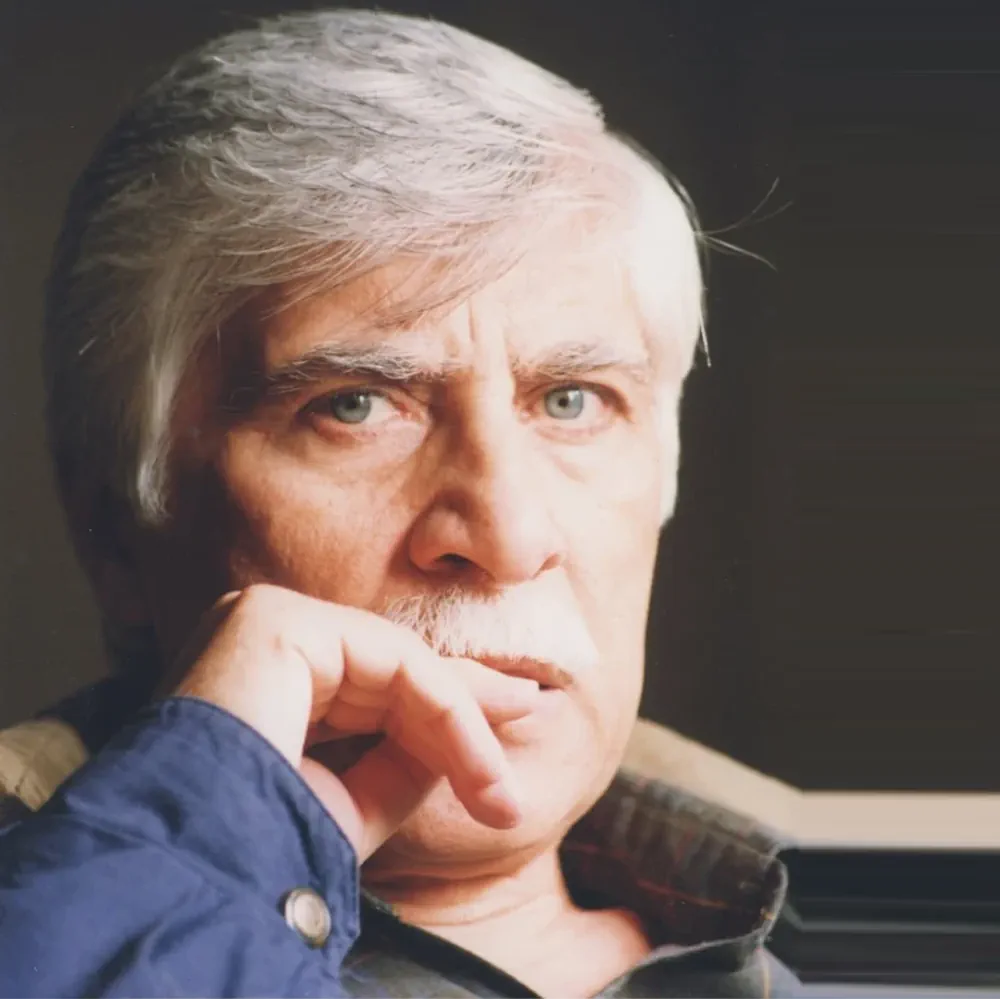
Bahram was born at the beginning of winter 1938 in Tehran. He grew up in a cultured, poetry-loving family where his father, Ne’matollah Beyzai, known by the pen name Zekāyi, a poet and researcher, filled the home with books and historical narratives. His family home became a meeting place of classical literature and modern intellectual thought. Before he ever studied at university, Beyzai learned the alphabet of theatre in the alleyways of Tehran, from street performers and ta’zieh storytellers. This early “watching” became the root of his lifelong connection with mythology and the Shahnameh.
Although his formal studies in Persian literature at the University of Tehran remained unfinished, his personal search through layers of history shaped his intellectual path. As a teenager, he became familiar with literary circles where figures such as Jalal Al-Ahmad and Akbar Radi were present. At nineteen, by writing the play Arash, he took his first major step in re-imagining ancient myths.
The Quest —

In the 1960s, Beyzai wrote the landmark reference book Show in Iran, creating the first comprehensive and scholarly history of Iranian performing arts. As one of the founders of the Iranian Writers’ Association, he later served as head of the Department of Dramatic Arts at the University of Tehran, educating a new generation of artists.
His entry into cinema in 1969 with the short film Uncle Moustache, followed by the masterwork Downpour (1971), signaled the arrival of a director who fused cinema with “architectural staging” and “dramatic precision.” After the 1979 Revolution, he faced severe restrictions and was dismissed from the university. Nevertheless, he never stopped creating. In 2010, he moved to the United States at the invitation of Stanford University. During the final fifteen years of his life in California, he continued teaching and staging major productions such as Tarab-Nameh, a grand revival of Iranian theatrical traditions in exile.
The Manifestation —
With more than seventy significant works, Bahram Beyzai became an architect of a new literary language in Iran. He created an “archaic” yet dynamic style in which history was not a distant past but a mirror for understanding the present. In his works, women appear as active, powerful, and wise figures who, unlike conventional portrayals, take control of destiny.
Among his most important plays:
The Death of Yazdgerd, Four Boxes, Sohrab-Killing, Afra, or The Passing Day, and A Passion Play in Memory of Master Navid.
Among his enduring films:
Downpour (1971), Ballad of Tara (1978), The Death of Yazdgerd (1981), Bashu, the Little Stranger (1988), The Travellers (1992), and Killing Mad Dogs (2001).
Bashu, the Little Stranger has consistently been praised as one of the pillars of Iranian cinema history.
The Echo —

Bahram Beyzai was not only an artist, but a true guardian of culture. By modernizing traditional forms such as naqqāli storytelling and puppet theatre, he presented national identity in a universal form. His influence on later generations, from filmmakers such as Asghar Farhadi to contemporary playwrights, remains undeniable.
He passed away on December 26, 2025, in Palo Alto, California. His legacy restored pride to the Persian language and revived a sense of identity buried in the dust-covered layers of collective memory. He taught that to build the future, one must first rediscover mythological and historical roots.