
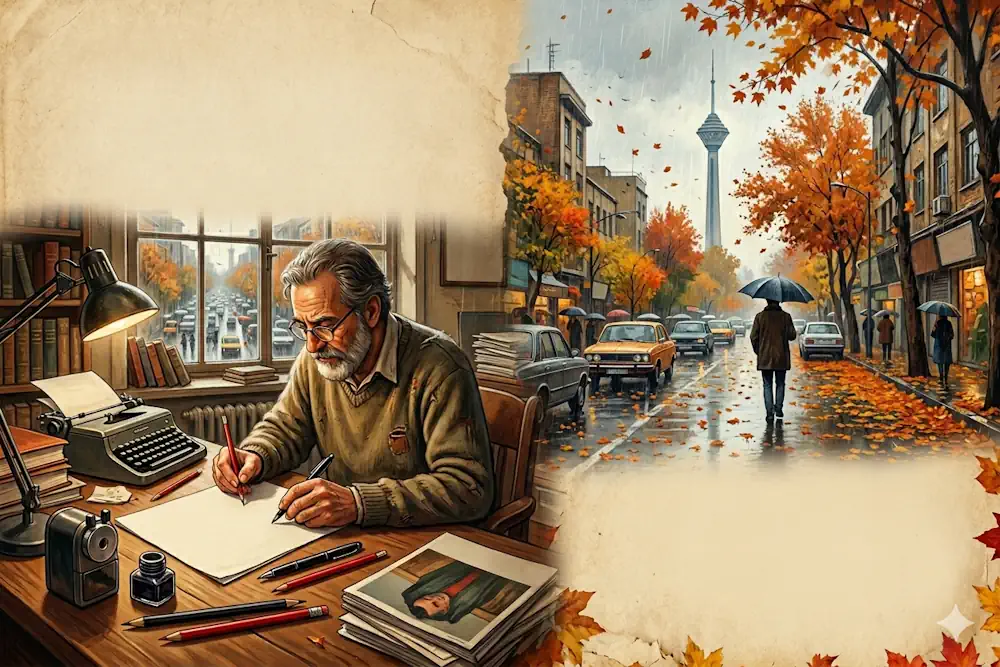
It was an autumn day, like that day…
The man in this story was busy working in the magazine office, and now exactly one month and three days had passed since the day when, unexpectedly and without notice, “the author,” the other figure in this story, had come to see him in that very office.
We must go back many years and say that it was one of those delightful autumn days in Tehran, the season when the plane trees shed their leaves. Yellow and red leaves fell across the sidewalks, and when it rained now and then, their scent mixed with automobile exhaust carried the smell of burnt coffee in the air. It was the season of festivals, what today would be called cultural and artistic events. Even the beauty of women seemed deeper in their faces during that time of year. It was also the season when the city’s chamber orchestra began its programs, and the man in this story, translator and editor-in-chief of a semi-official magazine for young readers, attended each performance eagerly. After a good story, nothing excited him more than the harmony of string instruments playing a Baroque piece.
It was an autumn day, and after years of teaching in a provincial town, he had finally found his desired job as editor-in-chief of a magazine in the capital.
Early in the morning, with his habitual meticulousness, he sharpened several black pencils along with two red ones. A folder containing a poem by Parvin E’tesami titled “The Orphan’s Tear,” along with an extensive introduction written by a literature professor, lay ready for final editing. He intended to avoid clichés and keep the introduction engaging for young readers.
Yet for several days now, a persistent question kept troubling him:
Why hadn’t he come? Why hadn’t “he” come to collect his payment?
That morning he visited accounting again.
“No, the cheque is still here,” the accountant said. “No one has come for it.”
A short story by “the author,” written years earlier, had appeared in the latest issue with an imaginative illustration. Yet the author had not come to collect the unusually generous payment. What might have happened to him?
The editor began to worry.
Before continuing, we should note that the editor is a real person. But as he himself believed, once a real person enters fiction, he becomes no more real than any fictional character. The other figure, the author, is also real. Yet now it seemed that perhaps the one who visited the editor had been not the author himself, but his ghost.
Had he committed suicide?
In such beautiful weather?
Reluctantly, the editor called a journalist who had once interviewed the author.
“Don’t wait for him,” the journalist said. “Maybe he’s forgotten altogether… But here’s the only number I have.”
A woman answered the phone.
“No, he’s not here.”
She hung up.
Folders lay on the editor’s desk, ready for printing. A reading lamp bent over sharpened pencils. Outside the window stood an abandoned old house, like a fragment of the city’s past frozen in time.
Years earlier, the editor had first met the author in a bookstore frequented by local intellectuals. The author had seemed like someone stepping out of his own stories.
Three knocks sounded at the door.
“Come in,” the editor said.
The door opened.
The author stood there, tall and thin, with his familiar half-smile.
“Bahram! You? Here?”
They embraced. Tea was poured.
“I was passing by,” the author said casually. “I heard you’re publishing a magazine.”
They talked. The author criticized cultural festivals, censorship, and commercialization. He spoke bitterly about writing.
“Writing only wears down the soul,” he said.
Later that day, the editor left the office, stopped at a café, read a memoir, and walked through autumn streets. A blind man sang. A child held a tin can.
Then suddenly he saw the author again approaching quickly.
“You people aren’t ashamed?” the author shouted.
“Why did you publish my work without permission?”
The editor trembled.
“But… you… yourself…”
They went to a tavern. They drank. They argued. They recited poetry. They cried. They walked along a quiet street and sat beside a stream.
The author leaned close and whispered:
“So… how much was the cheque?”
The editor stared at him.
The author’s eyes sparkled with a mischievous light.
The editor grabbed his collar.
“Damn you, Bahram…”
The smile returned to the author’s face.
They stood up and walked again, their shoes wet, in the cool autumn night.