
The Dawn —

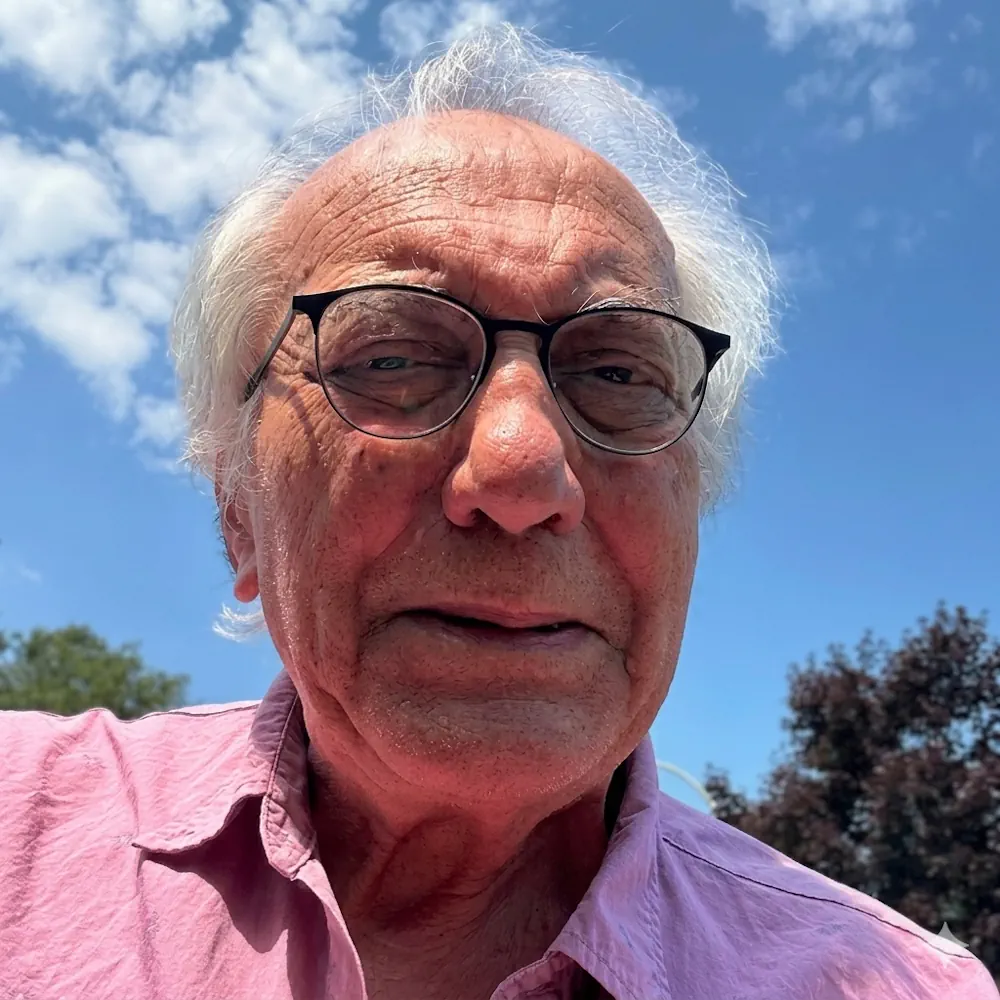
Reza was born in July 1949 in the city of Isfahan, Iran. His adolescence and early adulthood were shaped by the rich cultural and literary atmosphere of that city. He studied history at Pahlavi University in Shiraz, where he also entered literary circles.
His serious literary activity began in the late 1960s with the publication of stories in the influential literary magazine Jong-e Isfahan. This period marked the formation of his literary and intellectual outlook, when fiction writing, translation, and literary criticism gradually became his professional path. After completing his studies in Iran, he moved to Canada to continue his education and earned a Master’s degree in Communications from Concordia University in Montreal.
The Quest —

In the following decades, alongside the major cultural and social transformations of Iran and the post-revolutionary crises, Farokhfal continued his literary work. While maintaining a selective approach to fiction writing, he produced stories, essays, and translations, and worked for many years as an editor for various publishers.
His precision in language and textual structure led him to become one of the founders of one of Iran’s earliest editors’ associations. In the 1980s, he published his acclaimed short story collection Ah, Istanbul, his most recognized fictional work. This book established his reputation as a writer with a distinctive style and a thoughtful literary vision.
The Manifestation —

In addition to fiction writing, Farokhfal has been active in literary theory, criticism, and cultural research. His stories and analytical essays have appeared in various literary journals and collections both inside and outside Iran.
Among his notable works are:
- Ah, Istanbul (Short story collection, one of the notable works of the 1980s)
- A Celebration Elsewhere (Short story collection published last year, reflecting the continuity of his creativity)
- Sa’di’s Tale of Exile (Literary research)
- A Woman, the Ornament of Time: On the Poetic Life of Táhirih Qurrat al-Ayn (Historical-literary study)
- Translation of Monsignor Quixote by Graham Greene
- Translation of One Day in the Life of Ivan Denisovich by Aleksandr Solzhenitsyn
- Translation of a critical study on The Waste Land by T. S. Eliot
In later years, he published the English-language research book Sa’di’s Narrative of Exile, offering a new perspective on exile and displacement in Sa’di’s works. He also compiled the Persian language instructional series Persian: Here and Now, which has been used as a university-level teaching resource.
The Echo —

After emigrating to North America, Farokhfal began and continued his academic teaching career. He previously taught Farsi language and literature at McGill University in Montreal and at the University of Wisconsin.
He later served as instructor and coordinator of the Persian Language Program at the University of Colorado Boulder, where he worked for many years. During this period, his focus expanded to Persian language instruction, cultural studies, and literary theory. He sought to introduce Persian literature dynamically to non-Persian-speaking students. His teaching and research activities contributed to the fields of exile literature, Iranian culture, and Persian language education.
Reza Farokhfal, fiction writer, critic, literary theorist, and translator, is a writer who has consistently valued quality over quantity. From his first collection Ah, Istanbul to his later work A Celebration Elsewhere, he has created several memorable stories and contributed meaningfully to Persian fiction.
In literary theory and criticism, he has consistently approached subjects from new and unconventional perspectives, avoiding established frameworks. His writings often center on the relationship between literature, culture, lived experience, exile, cultural identity, and language.
Another aspect of his public voice, especially in recent years and online writings, includes direct and sometimes sharp critiques of contemporary and historical issues. With this approach, he often challenges established narratives and occasionally provokes strong reactions. Yet he has chosen intellectual independence and frankness in a context that demands courage. His view of literature is cultural and analytical; he sees literature as a means of understanding human experience and cultural memory, and both his fiction and criticism reflect this outlook.