
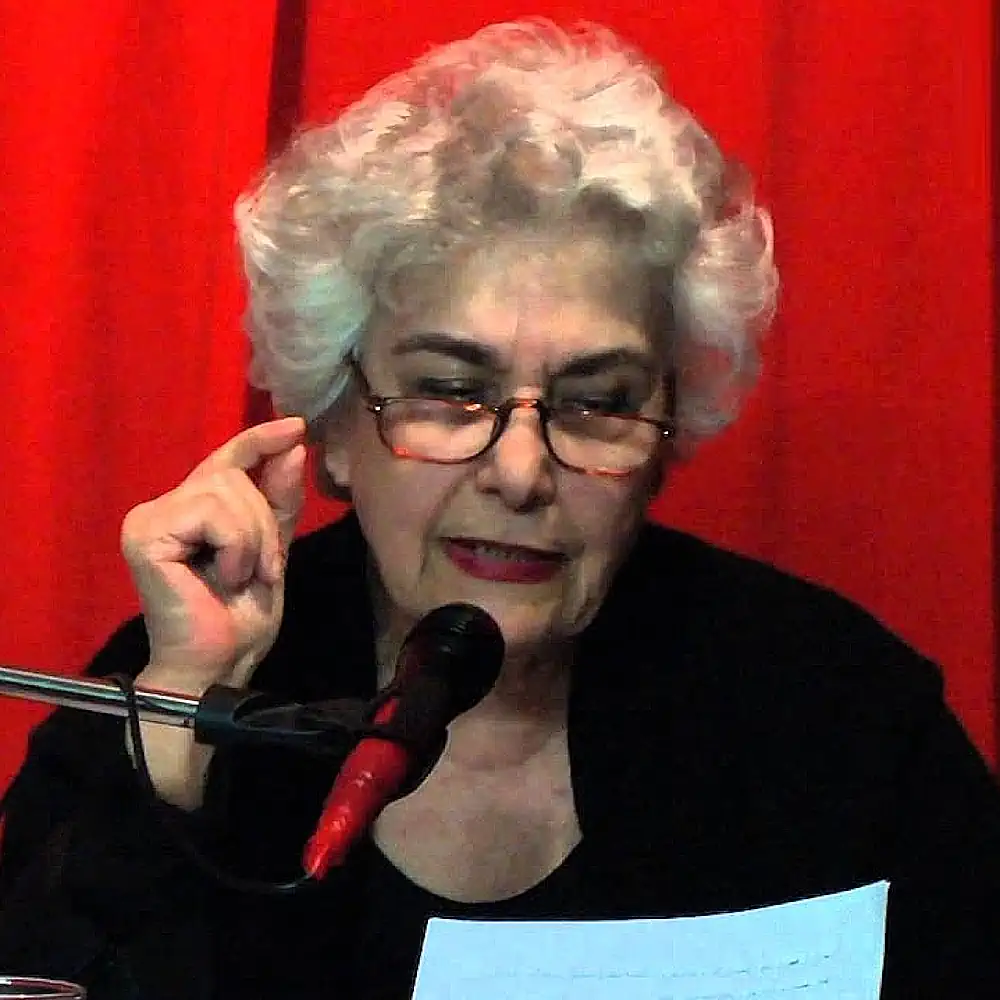
The Dawn —

Mahshid was born on 9 April 1937 in Kermanshah, Iran. Her father was a senior magistrate and her mother a political activist. She completed part of her schooling in Tehran and later continued her education in England at Charters Towers boarding school in Sussex. After receiving her O- and A-level certificates, she studied physics at Woolwich Polytechnic in London.
After returning to Iran in the 1960s, she worked as a teacher of physics and mathematics before joining the Franklin Book Program as an editor and translator, where she also helped develop children’s publishing projects.
The Quest —

Amirshahi began writing fiction in her youth, but her first published works appeared in the 1960s. Her early short-story collections—The Blind Alley (1966), Bibi Khanom’s Starling (1968), After the Last Day (1969), and In the First Person Singular (1970)—established her reputation as a notable voice in modern Persian short fiction.
Critics highlighted her subtle humor, lively dialogue, and skillful characterisation. Her stories often portray middle-class life, social relationships, and cultural tensions in contemporary Iranian society.
The Manifestation —

During the 1979 Iranian Revolution, Amirshahi publicly opposed Islamic fundamentalism and supported Shapour Bakhtiar. After the revolution she left Iran and settled in France, continuing her literary and intellectual activities in exile.
Among her most important works from this period are the novels Dar Hazar (1987) and Dar Safar (1995), which explore the revolution and the lives of Iranian exiles. She also wrote the four-volume novel cycle Mothers and Daughters.
In addition to fiction, she has written literary criticism and essays and has contributed to publications such as Newsday and the French journal Les Temps Modernes.
The Echo —

In exile, Amirshahi has remained active in defending freedom of expression and the separation of religion and politics. She was one of the founders of the Committee in Defense of Salman Rushdie in France and also supported writers such as Taslima Nasreen who faced threats from religious extremism.
She has delivered lectures at institutions including Harvard University and the French Senate.
Her clear prose, refined humor, and critical perspective on society have secured her a lasting place in modern Persian literature. Her novels Dar Hazar and Dar Safar are often regarded as significant works of Iranian literature in exile.
Among her honors is the Bita Prize for Persian Arts (2013) awarded by Stanford University for lifetime achievements in Persian culture and literature.