
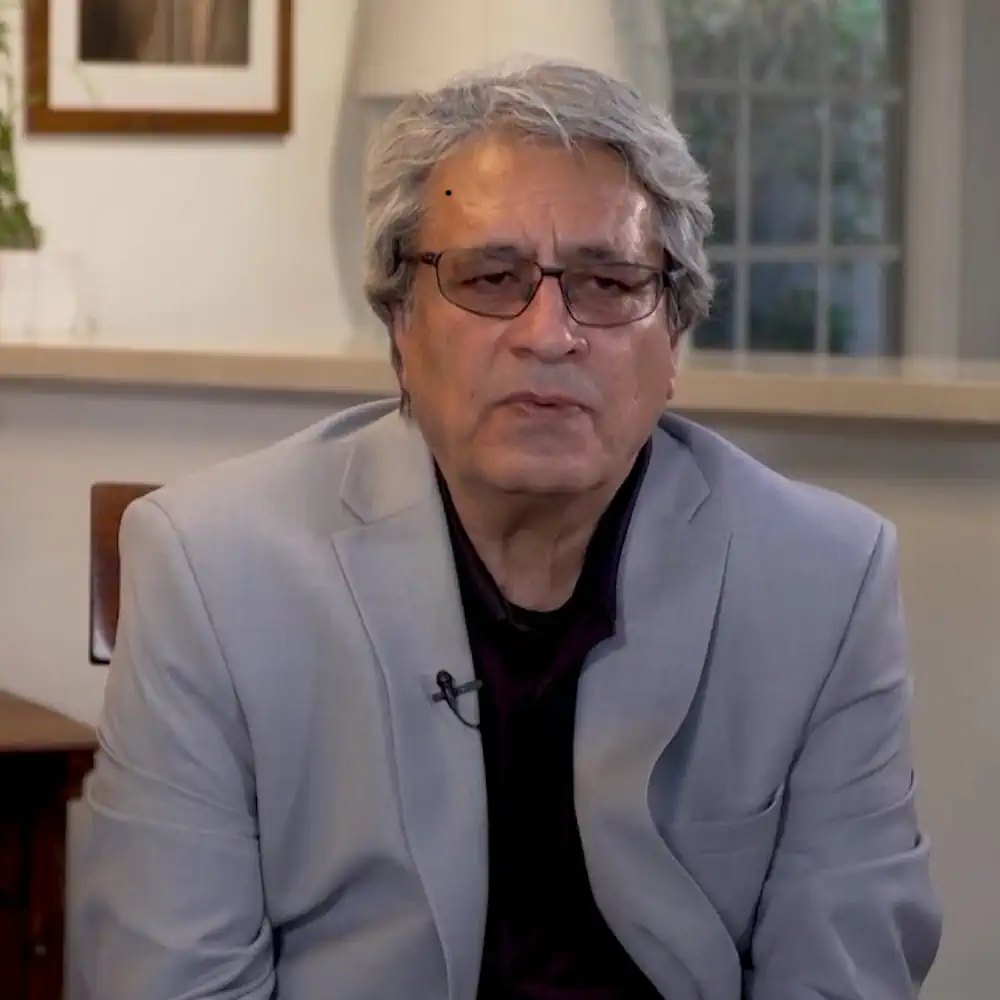
The Dawn —

Shahriar was born in Shiraz on February 15, 1957, in the heart of winter—the very same days when the Iranian Parliament passed the law to establish the National Intelligence and Security Organization (SAVAK). Raised in the cultural cradle of Shiraz, he was drawn to the world of words from early childhood; by the fourth grade, upon discovering the joy of composition, he consciously chose to intertwine his life’s path with literature.
The Quest —

To better understand the mechanisms of the world, Mandanipour studied Political Science at the University of Tehran, graduating in 1980. His life took a pivotal turn during the Iran-Iraq War, where he served eighteen months as a volunteer on the front lines. This harrowing experience of “writing under the shadow of mortars” deeply influenced his grasp of life, death, and human endurance. After years of serving as a librarian and director of the Hafiz Research Center, he moved to the United States in 2006 as an International Writers Project Fellow at Brown University.
The Manifestation —

A pioneer of the “third generation” of Iranian fiction, Mandanipour has pushed the boundaries of form and language with works such as The Courage of Love (Del-e Del-Dadegi) and the internationally acclaimed Censoring an Iranian Love Story. Beyond fiction, as a prominent literary theorist, he explored the alchemy of narrative in his seminal work, The Book of Shahrzad’s Ghosts. His tenure as editor-in-chief of the literary journal Asr-e Pandjshanbeh in Shiraz stands as a testament to his civic and cultural commitment to fostering literary critique and dialogue.
The Echo —

Mandanipour’s legacy is defined by his use of metaphor as a shield against censorship and oblivion. Described by critics as a “magician of language,” his works have been translated into over ten languages, bridging the gap between Eastern symbolism and Western postmodernism. He believes that literature is the transformation of reality into “fictional truth.” His enduring influence lives on through his students and his commitment to socially committed literature, proving that even in the face of hardship, one can “bring their small wheat field to harvest in autumn.”