Reviews:
Hadi Khojinian (Director of Mehri Publication) in an interview with Radio Farda:
Regarding the publication process of the book, he stated:
“Kiumars Pourahmad expressed intense joy about finally publishing a work without censorship. He used to say, ‘I feel as though my chest has finally opened up [to breathe].'”
Babak Ghafoori Azar (Radio Farda):
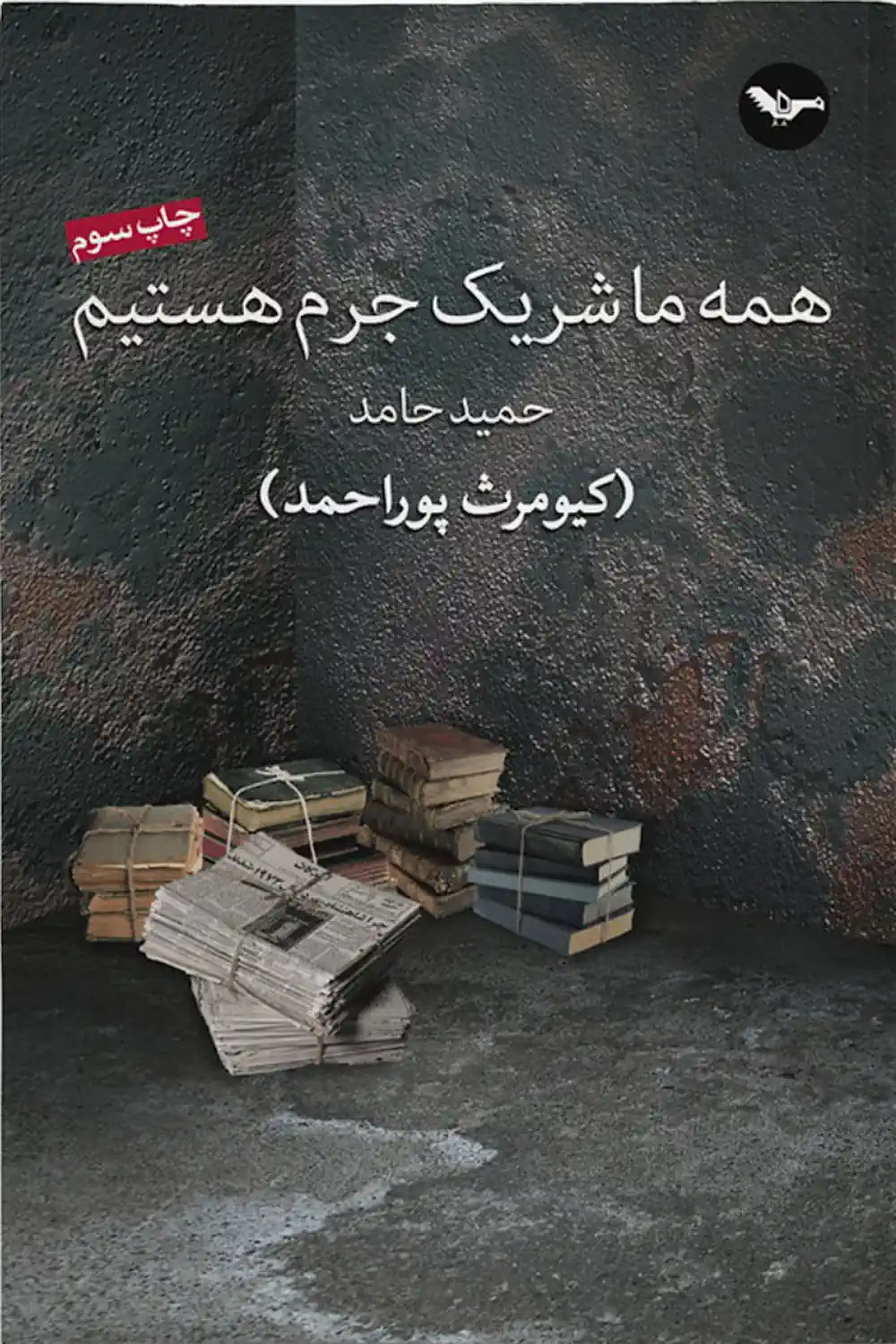
“The book We Are All Accomplices is an overt tribute to women and certain contemporary Iranian political figures, including Farrokhroo Parsa and Amir-Abbas Hoveyda.”
Mohammad Abdi (Phoenix Magazine – Toronto):
“The author, who—like many Iranians—is deeply embittered by the Revolution and Khomeini, unleashes years of suppressed anguish in the final fifty pages, seemingly unconcerned with how the tone and structure of these final chapters align with what preceded them. One can guess that for the author, uttering these unspoken words and unburdening his bleeding heart was more important than anything else.
Consequently, toward the end of the novel, the protagonist, Arash, is somewhat forgotten. What remains is the village that had been built and flourished before the Revolution—a clear symbol of Iran—which has now, by the 20th anniversary of the Revolution, turned into a ruin. The author concludes his novel with sentences more bitter than ever:
‘And Ava did not know that something far more grave, and much, much more lethal than leprosy, was crawling, crawling, crawling under the skin of all of Iran—and this was only the twentieth anniversary of the Islamic Revolution.'”
Paria Bahrami (Radio Zamaneh)
Linguistic Audacity and Narrative Critique
The novel employs a bold and uninhibited language. The depiction of erotic scenes, sharp socio-political critiques, and the candid behavior of characters in various situations—such as the scene where the village headman is deposed, the intimate encounters, and the women’s assertive defense of their rights in the public eye—all invite deep reflection. Arash, as the primary narrator, provides a critical intellectual framework that is particularly noteworthy.
Strengths and Shortcomings
This linguistic and thematic audacity occasionally teeters on the edge of popular fiction (Aame-pasand). Certain instances, such as Arash’s internal monologues regarding a villager’s crude interactions with an animal or similar bawdy jokes, border on the vulgar. Furthermore, an overindulgence in romantic banter in a few passages leads to prolixity and tedium.
Despite these flaws, the author’s overarching philosophy remains admirable: his promotion of tolerance, his rejection of immersion in tradition and religion, and his sharp, incisive gaze throughout the story.
Key Excerpts from the Novel
“What a pity for you young people, fallen into this cesspool of customs, traditions, religion, and rituals… You should be free from every shackle, free!” (p. 255)
“My father was looking for a place that had no Mullah (cleric). He used to say a village without a Mullah has more human inhabitants! A parasitic Mullah ruins everyone. He said a Mullah makes one’s world dark and gloomy; he robs you of your joy and high spirits.” (p. 245)
Overview

The novel “We Are All Accomplices” by Kiumars Pourahmad follows the life of Arash Azarpanah, the son of a high-ranking military officer in the Pahlavi era. Despite his privileged background, Arash chooses not to pursue a comfortable life or a government career. Instead, he joins the Literacy Corps and is sent to a remote desert village called Hejrak. The impoverished village lacks basic infrastructure such as education, healthcare, and clean water. Arash’s arrival gradually transforms the village: literacy spreads, public health improves, and hope emerges among the residents. Central figures in the story include Golbano, a strong and capable village woman who eventually gains authority within the community, and her daughter Mah-Jahan, a literature-loving young woman who goes on to pursue higher education. Through this narrative, the novel portrays Iran in the 1960s as a society moving toward modernization and reform, before the revolutionary upheaval that ultimately disrupts this trajectory.
Analysis

The novel is largely structured through Arash’s perspective and experiences, using the transformation of the village as a symbolic reflection of broader social change in Iran. The narrative explores tensions between tradition and rational thought, religion and secular life, and patriarchal authority versus emerging female agency. Female characters such as Golbano and Mah-Jahan play a central role in the narrative and represent the novel’s emphasis on women’s independence and social participation. Dialogues among Arash and other characters provide a space for discussing political and social ideas of the period. Alongside its social commentary, the story includes a romantic plot between Arash and Mah-Jahan. The author’s direct language, including candid descriptions of relationships and sexuality, gives the novel a bold and sometimes provocative tone. In the final chapters, the narrative becomes more overtly political, portraying the decline of the once-thriving village as an allegory for Iran’s condition after the revolution.
Reception

The novel attracted significant attention after publication. Some critics view it as an explicit tribute to women and to certain political figures of the Pahlavi era, including Farrokhroo Parsa and Prime Minister Amir-Abbas Hoveyda. Reviewers have noted the book’s outspoken tone and its frank discussion of social, political, and personal issues. While many readers appreciate its boldness and critical perspective on Iranian history, some critics argue that the final sections shift toward a more emotional and overtly political voice, reducing the narrative focus on character development. Despite these debates, the novel is widely regarded as a provocative literary reflection on modern Iranian history and the long-term consequences of the 1979 revolution.