
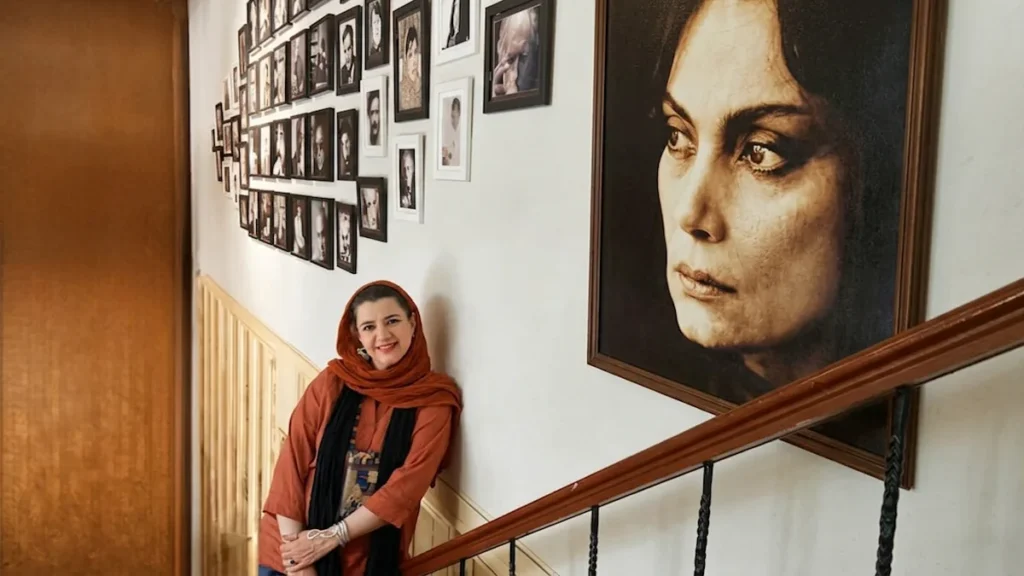
In a feature prepared by Zanan-e Emrooz »[1], two women fiction writers engage in a rich conversation: Negar Ghalandar and Laden Niknam. They discuss the life and journey of the late fiction writer Ghazaleh Alizadeh and arrive at a new novel written by Niknam and published by Seday-e Moaser: Staying in Overtime. Niknam explains her motivation for choosing fiction rather than nonfiction to write about Ghazaleh. She considers storytelling to possess a softness and depth beyond nonfiction writing. This is the same perspective we encounter in the House of Storyology of the Children of Misra and Santa, described as “knowledge-re-narration,” or retelling knowledge. Laden creates a character named Sara and places her in Ghazaleh’s position. Through this character, she attempts to test her understanding of living in solitude. We recommend reading this short but valuable interview to readers interested in storyology.
In the turbulent history of contemporary Iranian literature, Ghazaleh Alizadeh cannot be recognized merely as a gifted writer. She represents a singular and controversial presence whose meaning emerges at the intersection of language, gender, and reflective living. Through both her works and her distinctive way of life, she achieved a unique place in contemporary Iranian literature. Yet despite the depth of her influence, that place has remained somewhat marginal and not fully recognized or evaluated. Perhaps because she consistently moved against familiar currents and stepped into less-explored territories.
Ghazaleh Alizadeh blurred the boundary between living and writing. She viewed language not merely as a tool for storytelling but as an intellectual space for confronting clichés, silences, and structures of domination. She sought to free the feminine world from passivity and marginalization, transforming it into a space of power, inquiry, and tragic beauty. Everything associated with her name represents more than literary works. It embodies rebellion, resistance, and a desire to break from dominant structures.
In this conversation, Laden Niknam, author of Staying in Overtime, a novel inspired by Ghazaleh Alizadeh’s life and inner world, speaks about her deep and multilayered influence on her own thinking and writing. She describes an emotional and empathetic bond that led her to a bold and precise reading of Alizadeh’s character and life. This interview is not only a reflection on the life and death of a mysterious writer but also an attempt to reconsider the position of the intellectual woman in Iranian literary tradition, a woman not yet fully seen and works perhaps still ahead of their time.
Ghazaleh Alizadeh is a writer whose personal life has always drawn considerable attention, from her marriages and solitude to the will she left behind. Even after her death, rather than a clear portrait, she remains surrounded by ambiguity, as though people prefer to see her as mysterious. Since you have researched her for years and addressed her in your novel Staying in Overtime, I would first like to know your view of her personality.
In my opinion, Ghazaleh Alizadeh stood out early because of her striking physical beauty and exceptional intelligence. Looking at her fields of study, philosophy, literature, law, and political science, shows she was always learning. She continued learning until the end of her life. At the same time, her constant connection to classical Persian literature, such as her references to Tarikh-e Beyhaqi and classical poetry, reveals her deep loyalty to roots.
We should remember that during her lifetime, some women of her generation gained advantages through physical beauty, often by marrying wealthy men and living comfortably. Ghazaleh chose a different path. While aware of her beauty, she pursued intellectual beauty. She tried to define a new mechanism for her mind. She chose meaning over appearance and worked to cultivate her mind in deeper ways.
This choice, I believe, marked the beginning of the complexity of her life. Each new book she published provoked varied reactions. Few expected someone with her appearance to produce such intellectual depth. She wanted people to move beyond appearance toward meaning, but it is unclear how many truly did.
Her personal life also shaped her writing and behavior. She sought both to give love and receive it. In a society like ours, this combination, beauty and generosity, can sometimes create difficulties for women.
So you believe society could not easily accept the combination of beauty and intellectual depth?
Exactly. Society unconsciously assigns a fixed role to a beautiful woman. If she moves beyond that role, she is either ignored or portrayed as mysterious. From her early twenties, Ghazaleh had significant emotional experiences, including marriages to prominent cultural figures. These experiences, combined with her personality, created a life filled with contrasts.
During my research, I noticed something interesting. Unlike writers such as Simin Daneshvar or Shahrnush Parsipur, people rarely referred to her formally. They simply called her “Ghazaleh,” as if she were close to them. This reflected the intimacy she created.
However, alongside this warmth, she also struggled with depression. These contradictions appear in her novels, especially The House of the Edrisis, where characters feel carved and shaped rather than simply created.
Her being a beautiful and compassionate woman contributed to her being underestimated. Society focused on appearance rather than meaning.
So stereotypes about women overshadowed her work?
Yes. At some point, the writer herself became the text. She seemed to say, “My skin has been stripped. I wrote The House of the Edrisis. Refer to my text, not me.” Yet assumptions about women writers prevented this.
Despite creating a brilliant work, a cultural heritage for Iranian fiction, many could not accept that she was more than a face. Her personality overshadowed her writing, which should have been central.
Another point that draws attention in her life is her inclination toward solitude and retreat. Some believe this isolation played a role in shaping her worldview and writing. How do you see this?
Solitude, in Ghazaleh Alizadeh’s life, was not merely withdrawal from society. It was a conscious choice. She sought a space where she could think, read, and write without interruption. In that sense, solitude became a creative environment for her. But at the same time, this solitude intensified her emotional sensitivity. She experienced relationships deeply, and when those relationships weakened or collapsed, the emotional impact became stronger.
This duality, the need for solitude and the need for connection, created tension within her life. In many ways, this tension appears in her characters. They often search for belonging while simultaneously resisting it. In The House of the Edrisis, we see characters caught between attachment and detachment, tradition and transformation. This mirrors Ghazaleh herself.
When I was writing Staying in Overtime, I tried to understand this solitude not as weakness but as strength. I created the character Sara to explore what it means to live in isolation while still seeking meaning. Sara is not Ghazaleh, but she carries emotional echoes of her.
Some readers believe writing fiction about a real person risks distorting reality. Why did you choose fiction instead of biography?
Because fiction allows emotional truth. Biography is limited to documented facts. Fiction allows us to explore inner worlds. In Ghazaleh’s case, her inner life is essential. Without understanding her emotional landscape, we cannot understand her writing.
I did not want to claim that Sara is Ghazaleh. Rather, I wanted to explore what it means to think like her, to feel like her, to face similar contradictions. Fiction made this possible.
Also, fiction provides distance. That distance protects both the writer and the subject. It allows interpretation without claiming certainty.
Ghazaleh Alizadeh’s death also contributed to the aura surrounding her. Some consider it tragic, others see it as part of her complex personality. How do you interpret it?
Her death remains painful and difficult to interpret. I do not see it as a simple act. It reflects accumulated emotional pressures, solitude, illness, and perhaps disappointment. But reducing her life to her death would be unfair. Her work, especially The House of the Edrisis, remains her true legacy.
We should focus on her writing rather than the manner of her death. Her texts continue to speak. They remain alive.
In your opinion, what is Ghazaleh Alizadeh’s place in contemporary Iranian literature?
I believe her place is still being formed. Writers such as Simin Daneshvar and Shahrnush Parsipur have received broader recognition. Ghazaleh, however, remains slightly outside the mainstream. Yet this distance may strengthen her legacy. Sometimes writers ahead of their time are recognized later.
Her language, themes, and narrative structure were complex. She did not write for easy reading. She demanded patience and reflection. This may have limited her immediate audience but increased her long-term significance.
For me, Ghazaleh Alizadeh represents courage. Courage to think differently. Courage to live differently. And courage to write beyond expectations.
Another important question concerns the continuing influence of her work. Do you think younger generations still connect with her writing?
Yes, I believe they do, though perhaps gradually. Writers like Ghazaleh Alizadeh do not always gain immediate popularity. Their work often requires time. Younger readers today, especially those interested in identity, gender, and inner life, may find her writing increasingly relevant.
Her narratives explore power, vulnerability, and the complexity of human relationships. These themes remain universal. In The House of the Edrisis, for example, the shifting social structures and the psychological transformation of characters resonate with contemporary readers facing rapid cultural change.
You mentioned earlier that you formed an emotional connection with her. Did that connection affect your writing process?
Very much. While writing *Staying in Overtime*, I often felt I was in dialogue with her. Not literally, but intellectually and emotionally. I tried to imagine how she might respond to certain situations. This process helped me shape Sara’s character.
At the same time, I tried to maintain distance. I did not want admiration to turn into imitation. My goal was not to recreate her voice but to explore the questions her life raised.
Do you think readers need to know her biography before reading her works?
Not necessarily. Her texts stand independently. However, knowing her life may deepen understanding. Her solitude, her relationships, and her intellectual pursuits all echo in her narratives. But even without that knowledge, readers can still experience the emotional depth of her writing.
Finally, if you were to describe Ghazaleh Alizadeh in a few words, what would you say?
I would describe her as a writer of contradictions. Beauty and intellect. Solitude and compassion. Strength and fragility. These tensions defined her life and shaped her writing. Perhaps this is why she continues to intrigue readers.
Her work invites us to look beyond surfaces, beyond easy interpretations, and toward the deeper layers of human experience. And that, in my view, is the mark of a lasting writer.
[1] “Women Today” ↩
A specialized magazine focused on women’s issues and one of Iran’s best-selling publications, it has been published in Tehran since June 2014. The magazine addresses Iranian women’s social, cultural, scientific, literary, and artistic concerns, aiming to inform, empower women, and raise awareness among society, policymakers, and decision-makers. Its content includes expert articles, interviews with specialists and prominent activists, and coverage of relevant events, published in print, on its website, and across social media platforms.