
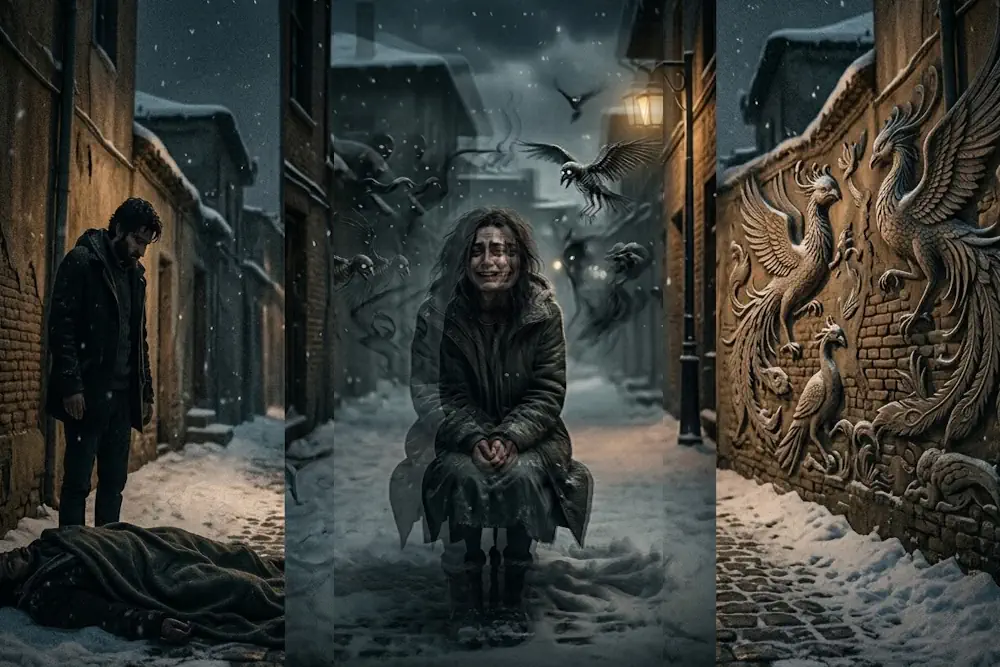
Nayer walked through the snow-covered winding alleys. Her nose was red, her coat brown. She was a schoolteacher. For five years, since her parents had died, she had lived with her mad brothers in an old house. She stopped at the wooden door, unlocked it, and went inside. The willow and pine trees were buried in snow. She crossed the icy, slippery yard with care and reached the veranda. Around it were five unoccupied rooms. In the sixth room, she lived with her mad brothers.
A stool had been placed in the middle of the veranda. Her older brother, Mahmoud, stood on it, giving a speech. When he finished, he stepped down. Her second brother, Hamed, climbed up.
“Gentlemen, please, no more applause. You embarrass me with such displays of emotion. Let us begin. We count. One, two, three. Silence, please. Silence, because my mind is scattered and refined, and I may forget everything. I am a teacher in public schools. I have lived an honourable life. Excuse me, sir, your tie is loose. Please sit more properly. You are in the presence of a man of letters, a speaker. It is a shame to let yourselves go and snort like eighty-horsepower pumps, you lazy, overfed men. Were you not the ones who shrouded my mother? Do you not remember sitting by her grave, making necklaces from the damp flowers of petunias? Does this not shame you?”
A sob broke out.
“Where is that crying coming from? Who is it interrupting my speech? A treacherous rat? Or a horse?”
Nayer stepped forward and shouted, “Enough! Stop it! God, silence you. Save these speeches for when I’m not here. Why didn’t you speak all day when you were alone? You say all this in front of me just to hurt me?”
They lowered their heads. She stood silent for a moment, then stepped closer, stroked their hair, and said gently, “All right, that’s enough. Now we make peace.”
Until dinner, the three of them stayed quiet. Only Hamed kept scratching his ears, making an unpleasant rasping sound. Mahmoud, with exaggerated grimaces, showed his disgust at him. Nayer gathered the dishes and washed them under the tap. Outside, it was snowing. She checked the time. It was a quarter past eleven.
“It’s time,” she said. “Everyone’s asleep now. They won’t see you.”
The brothers leapt with joy and began dancing in the middle of the room.
“That’s enough,” Nayer said. “We have to go.”
Hamed tried to go out barefoot. Nayer stopped him, put on his socks and shoes, and helped him into his coat. The three of them set out. As they crossed the yard, Hamed burst into song. Mahmoud bit his elbow. Nayer said sharply, “If you’re going to start already, we’d better go back.” They pleaded and promised to behave.
They stepped out into the alley. Snow-filled lanes twisted like white ropes into the distance.
“Choose a lane,” Nayer said.
Hamed picked the one on the left. In the middle of it stood an old tower with a dome. Mahmoud, almost crying, said, “Let’s go right, we’ll reach the street.”
“No,” Nayer said. “We go through the middle one. It’s a dead end.”
They entered it. At intervals, dim blue lamps burned on wooden poles. The heavy snow looked bluish. Mahmoud began doing somersaults. In the middle of the alley was a dark cistern with thirty or forty steps leading down. Hamed leaned in and shouted. His voice echoed in the hollow. Nayer pinched his arm.
“When will you stop fooling around? Can’t you see people are asleep? Learn from your brother.”
Hamed glared at Mahmoud, then began tumbling as well. They rolled in the snow like spinning tops. Nayer could barely hold back her laughter. They went up and down the alley several times.
“I’ve got an idea,” Hamed said. “Let’s have a contest.”
“What kind?”
“Rolling. We roll on the ground. Whoever gets there first wins.”
“All right. One, two, three.”
They rolled quickly. Snow curled and scattered around them. Mahmoud reached first, jumping up and shouting, “Winner! Winner!” Hamed stared at him with burning eyes.
“Well done,” Nayer said. “You won.”
Hamed muttered, “You like him more. You always did.” Then he shouted, “That doesn’t count. You cheated. We go again.”
“I cheated?” Mahmoud said. “You lost, that’s all. Don’t be jealous.”
He turned to Nayer. “What’s wrong with me?”
“Your firewood is damp,” she said.
“See?”
“But he’s nosy,” Hamed shot back.
“That’s enough,” Nayer said. “Don’t fight over something so small. What difference does it make who wins?”
“It matters to me,” Hamed said.
“Then die of jealousy,” Mahmoud said.
Hamed struck him in the face with his fist. Mahmoud shouted, “Now you’re hitting me? If you’ve got the nerve, come on—” He drove a hard kick into his stomach. Mahmoud doubled over in pain and fell. Nayer pleaded, “Please, stop. I beg you. People will wake up.”
Hamed got up and moved toward him. They grappled. Nayer threw herself between them, but under the force of their blows she couldn’t hold them back. Both had taken on a frightening strength. She stepped aside, pressed against the wall, and began to cry.
They writhed together on the snow, panting like horses, clawing and biting each other’s faces. A large stone lay by the wall. Hamed seized Mahmoud’s leg and dragged him toward it. Nayer screamed and begged. Mahmoud struggled, his eyes bulging. The dull light of the lamps fell across his face. The alley was as empty as a graveyard.
Hamed lifted his head and smashed it against the sharp edge of the stone. The crack of his skull breaking could be heard. Nayer wailed, tearing at her face. Dark, warm blood ran across the snow. Hamed, his eyes wild, stared at the gush of blood.
Mahmoud tried to rise. Hamed slammed his head against the stone again. A few short, muffled groans came from his throat. His limbs twitched, then he lay still on the blood-soaked snow.
Hamed drew back to the wall, staring blankly at a fixed point. Nayer trembled. Her heart pounded to the point of suffocation. A sharp pain shot through her head. She felt as though a thick molten substance were flowing through her skull. She was losing her balance, growing lighter.
She went to the body and knelt. With clawed fingers she scattered snow, trying to cover it. She pressed the legs together and piled snow over them. The body was buried up to the waist.
She lifted her head and fixed her cold, empty eyes on Hamed. For a while she was silent. Then suddenly she burst into laughter.
“You sly one… you finally finished him.”
She looked down again, then backed away, trembling.
“Look at the tarantulas. They’re licking his blood. Creatures with wolves’ bodies and human heads… licking his blood. Do you see them?”
“I don’t see anything,” Hamed said quietly. “What tarantulas?”
She pointed at the corpse. “How can you not see them? Are you blind, or pretending?”
“Tarantulas,” he repeated with a smirk.
Nayer looked up at the violet night sky. Huge black birds circled above them, then settled on the tall wall opposite. One of them laughed.
“Come look! Someone’s killed his brother. Motsovits, gather around!”
“They were great birds, with burning yellow eyes and human tongues.”
“What about them?” Nayer said. “Don’t you see them either?”
“I see nothing,” Hamed said. “I’m blind.”
A hatch opened. An old woman extended her hand with a red lantern and laughed with her toothless mouth. The lantern’s light glowed inside the hollow.
“Good night. Good night, my dear friends. Sleep well.”
She shut the hatch. The lantern went out.
Brother and sister set off. Passing the cistern, Nayer leaned in and called out. Her voice echoed in the void. Hamed laughed and mimicked her.
“Now that Mahmoud is gone,” he said gently, taking her hand, “you’re my mate, right?”
Nayer smiled, a little shy.
“Yes.”