Summary of Key Ideas from the Interview with Shiva Arastooei
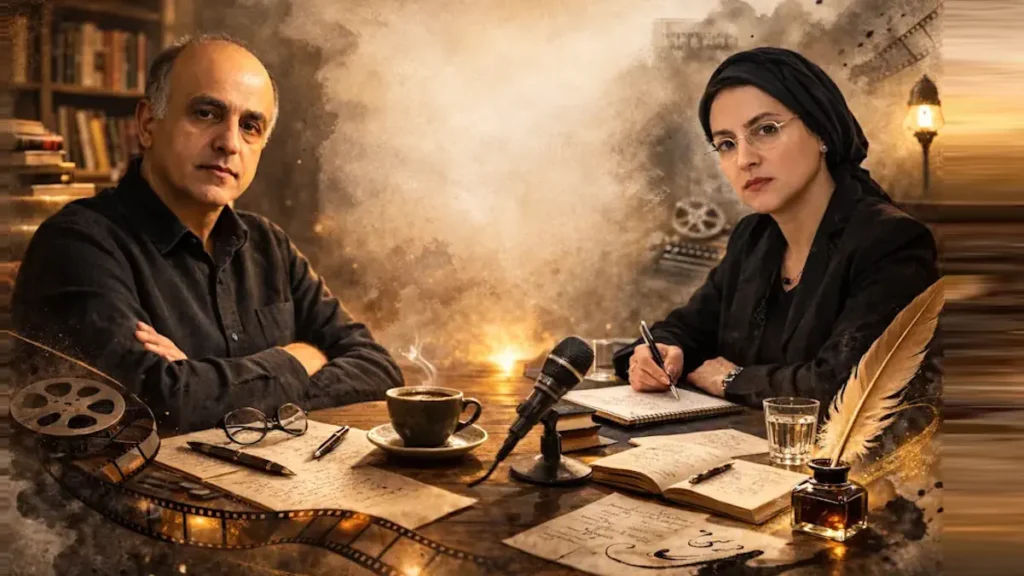
In this interview by film scholar and critic Dr. Parviz Jahed, Iranian writer and translator Shiva Arastooei discusses the relationship between literature and cinema, as well as the cultural conditions shaping contemporary Iranian storytelling. Their conversation explores the tensions and connections between literary and cinematic storytelling, artistic institutions, and the lived realities that influence writers and filmmakers.
The interview was originally written in Farsi. This English version has been prepared by the Scions of Santa House for our English-language members.
One of Shiva’s central arguments concerns the erosion of trust between filmmakers and writers in Iran. She notes that collaboration between cinema and literature once held greater creative potential, but over time the relationship weakened. According to her, writers often feel that their work is used superficially by filmmakers, while filmmakers may approach literary texts merely as raw material rather than as complex artistic structures. As a result, the organic dialogue that could exist between these two arts has largely disappeared.
Arastooei also emphasizes the distinct narrative capacities of literature compared with film. She argues that literature possesses a deeper interior dimension because it can enter the consciousness of characters in ways that cinema struggles to reproduce. While film relies primarily on images and external action, fiction allows the writer to explore psychological nuance, internal monologue, and the hidden motivations of characters. For this reason, she considers literary narrative uniquely capable of addressing the complexities of human experience.
At the same time, she acknowledges that cinema and literature influence each other. Writers may absorb cinematic techniques such as visual pacing, scene construction, or montage-like transitions. Yet Arastooei warns that literature should not imitate cinema too closely. When fiction becomes overly cinematic, it risks losing the richness of language and reflection that distinguishes it from visual storytelling. For her, the task of a writer is to preserve the autonomy of literary language while remaining open to insights from other arts.
Another important theme in the interview is the role of personal experience in writing. Arastooei believes that authentic storytelling often grows from lived reality. Writers inevitably draw from their own lives, emotional memories, and social surroundings. However, she stresses that literature should transform experience rather than merely reproduce it. The writer’s craft lies in shaping raw life into a structured narrative that reveals deeper truths about human relationships and social conditions.
Arastooei also reflects on the position of women writers in Iranian literature. She notes that women have played an increasingly significant role in shaping contemporary fiction. Their voices have introduced new perspectives on family life, social pressures, and emotional identity. Nevertheless, she suggests that female authors still face structural challenges, including limited institutional support and social expectations that shape how their work is received. Despite these obstacles, she sees the emergence of women writers as one of the most dynamic developments in modern Iranian storytelling.
A related topic in the interview is the cultural environment surrounding literature in Iran. Arastooei describes a complex situation in which writers operate under multiple constraints, including censorship, publishing limitations, and shifting cultural priorities. These conditions influence not only what writers can say but also how stories are structured and distributed. Yet she argues that literature continues to survive precisely because writers adapt creatively to these pressures. Storytelling becomes a subtle form of cultural expression that can convey meaning even within restricted spaces.
The conversation also addresses the relationship between literature and social reality. Arastooei believes fiction should remain attentive to the lived experiences of ordinary people. Literature that disconnects itself entirely from social life risks becoming empty formalism. At the same time, she cautions against reducing literature to political commentary alone. A successful story balances artistic form, emotional truth, and social awareness without allowing any single element to dominate completely.
Another issue raised in the interview concerns the craft of narrative structure. Arastooei explains that a strong story requires careful attention to voice, rhythm, and character development. She suggests that writers should remain sensitive to the musical quality of language and the pacing of scenes. The structure of a narrative, in her view, functions much like architecture: each part must support the whole while guiding the reader through a coherent emotional journey.
Throughout the interview, Arastooei returns to the idea that literature remains a space for intellectual and emotional freedom. Even when external conditions limit expression, storytelling can reveal hidden layers of experience and thought. Writers therefore carry a responsibility not only to create art but also to preserve the imaginative possibilities of language.
In conclusion, Arastooei’s reflections present literature as a dynamic field shaped by artistic dialogue, personal experience, and social context. Her perspective highlights both the challenges facing contemporary writers and the enduring power of storytelling. Despite institutional obstacles and the changing relationship between literature and cinema, she believes that narrative remains one of the most vital ways to understand human life and culture.