
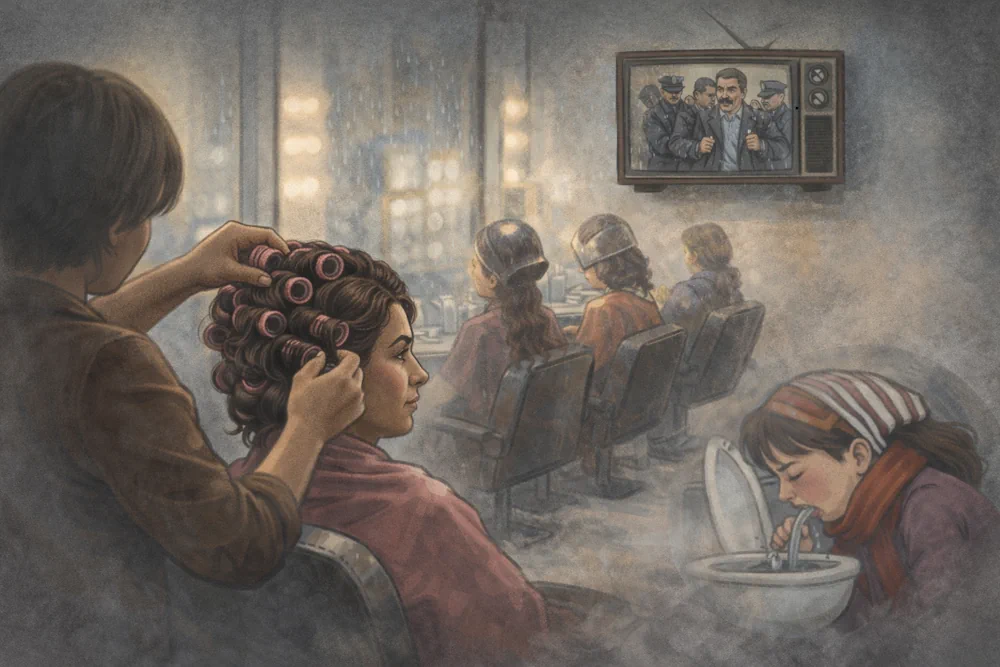
Razmik unwound a lock of hair from a large roller. She tossed the roller into the basket beside the mirror. Ten or twelve more rollers were fastened onto the large head beneath her hands. Zahra swept the cut hair into a dustpan. Razmik called her to come help.
The fat woman whose hair Razmik had cut brushed the tiny clippings from the back of her neck. Shahrzad watched the brush move across the thick neck and quietly scratched the back of her own neck.
Mrs. Colonel, as always, whispered into the telephone.
The fat woman straightened her skirt in front of the mirror and walked toward Mrs. Colonel’s table to pay.
Razmik opened the fifth roller from the fifth section of the large head. She pulled the big round brush from the roots to the ends. Zahra lowered the hand dryer as Razmik moved her hand.
Just then Brother opened the door and stepped in. Raindrops dripping from the tip of his umbrella fell onto the salon floor. He shut the door against the cold behind him.
Shahrzad looked at the clock. In ten minutes, if it whistled and they left, they would reach the next showing at the cinema. She hugged Brother and kissed him.
Razmik threw the round brush onto the counter and came over to greet him. Mother was still in the bathroom washing the dirty towels.
Mrs. Colonel asked Brother about his university courses. Every Friday she asked how many units he had passed, and every Friday she forgot again. Brother answered more briefly each time. This time he did not answer at all.
“Did you hear the news?” he asked Razmik.
Mrs. Colonel did not like them talking about “the news.” Whenever they did, she would place a record on the gramophone and turn up the volume.
Mother came out of the bathroom carrying a large basket of clean laundry. On Fridays Mrs. Colonel always sent her own clothes to be washed along with the towels and dirty aprons. Mother pretended not to mind. Mrs. Colonel tipped well.
Brother was not in the mood.
Shahrzad wanted them to leave soon. She wanted to wear the new hat Mother had knitted for her, wrap the red wool scarf around her neck, and walk beneath Brother’s black umbrella through the rain to the cinema.
But Brother sat talking with Razmik. Zahra stood with the dryer in her hand, waiting. From the gramophone the singer shouted:
“…Fridays, blood instead of rain…”
Brother’s umbrella had not yet dried.
Razmik offered cigarettes to Mrs. Colonel and Brother. All three lit them. Shahrzad kept watching the clock. Friday evenings were the best time for the cinema. But this Friday Brother did not care.
Mother wrung the laundry on the cold balcony and said,
“In this rain? Who goes to the cinema?”
Brother narrowed his eyes toward the window and smoked.
Razmik returned to remove the rest of the rollers. Straight hair was fashionable now. Women came to the salon to have their hair straightened.
Shahrzad liked curly hair more. Her own hair was neither straight nor curly. In winter she liked the hats Mother knitted. Her hair did not matter to her.
But this Friday Brother did not look at her hair, nor at her new hat, nor at her red scarf. He flicked cigarette ash into the tray and watched the rain.
He wore a white shirt Nahid had bought him. Shahrzad liked Nahid very much. Nahid always looked after Brother. Whenever he saw her, he calmed down.
Mother said Nahid was fat.
Brother said she was not fat, only full-figured.
Shahrzad agreed.
Since the night when three ill-tempered strangers had knocked on the door and taken Father away, Mother would not let Shahrzad go anywhere alone.
One of the men had sneered and told Father:
“When your little girl becomes a woman in front of your own eyes, maybe you’ll learn.”
Father had lunged at him.
From that night Shahrzad wished she would never become a woman. She only wanted to stay small, go to the cinema with Brother and Nahid on Fridays, eat bologna sandwiches, and wait for Father to come home so they could draw together.
Later Razmik turned on the television.
On the screen a man stood behind a table in a courtroom.
Shahrzad recognized him. She had seen him in a café where Father sometimes took her. She never forgot the man’s wide moustache when he recited poetry.
Father used to say, “That’s not poetry, it’s slogans.”
The man used to reply, “Slogans move the people.”
Now the man stood in court and said loudly:
“I will not bargain for my life in this court.”
Everyone in the salon watched silently.
The rain still struck the windows.
Later they said the man would be hanged.
As they led him away he passed two women. One had long straight black hair; the other had curly hair. They had been pardoned. The woman with the straight hair hugged the curly-haired one with joy.
Shahrzad did not understand why the man must die and the two women were forgiven.
She only missed her father.
She wrapped the red scarf around her neck and put on her new hat.
Nahid asked, “Shahrzad, shall we go see the Chicho Franco film?”
Even though it was late, Mother did not protest.
“No,” Shahrzad said.
Razmik said, “I’m going to buy bologna sandwiches. Shahrzad, want one?”
The smell of cold meat filled Shahrzad’s nose. She ran to the bathroom. Nahid followed her.
Shahrzad retched over the sink.
In the mirror she could see them all behind her.
Brother and Razmik were scratching their necks for no reason.
Since that Friday, the smell of bologna always made Shahrzad sick.