The story opens with a mystical anecdote from Shams Tabrizi about a man who searches for treasure by shooting an arrow. After failing repeatedly, he learns that the instruction never said to pull the bowstring. When he simply places the arrow on the bow, it falls at his feet, revealing that the treasure was always close by. The parable suggests that meaning is often misunderstood when instructions are interpreted too literally.
The narrative then shifts to Tehran, where political tensions fill the air. Outside the University of Tehran, students protest for freedom while opposing groups shout rival slogans. Riot police stand ready to intervene, and the atmosphere grows increasingly volatile.
Among the crowd stands a young woman wearing a black scarf and coat. She holds a placard with a strange slogan:
“Death to captivity; death to freedom.”
No group claims her. Protesters, government supporters, and secret police all interpret her differently—some think she is a spy, others assume she belongs to a rival faction. In truth, she belongs to none.
As tensions rise, the narrator foreshadows that within minutes the chaos will lead to her death during the clash between protesters and security forces.
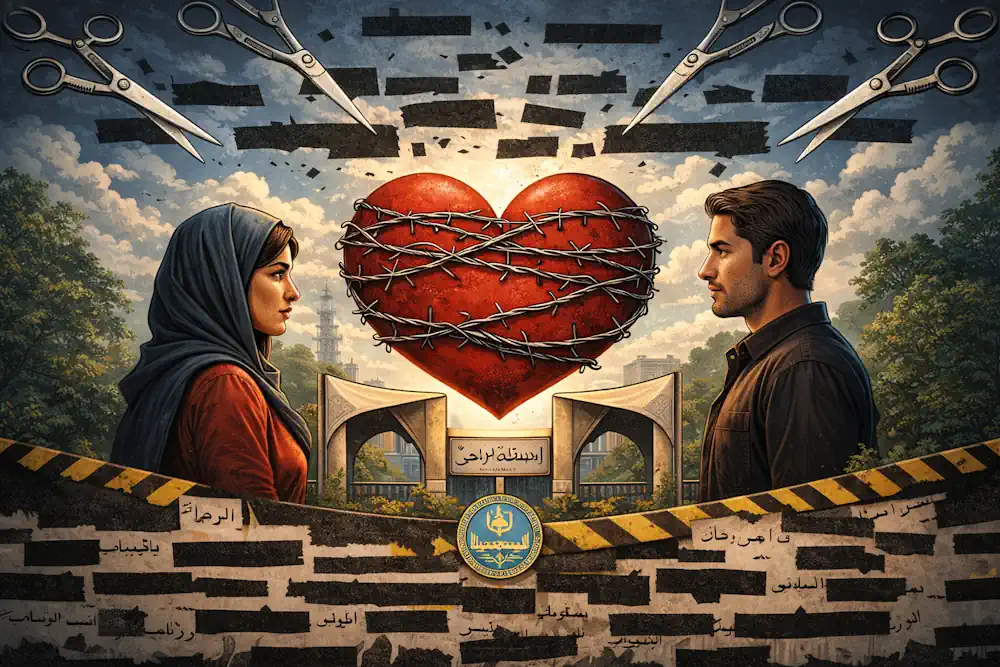
The narrator then reveals himself as a writer who wishes to write a love story but struggles because publishing fiction in Iran requires approval from government censors. He describes the absurd and oppressive mechanisms of censorship, embodied by a bureaucrat who scrutinizes every word for moral or political violations.
Because of these restrictions, even writing about love becomes difficult. The narrator explains that in Iranian society, interactions between unrelated men and women are heavily controlled, making a simple romantic narrative almost impossible to publish.
Nevertheless, he decides to attempt writing a love story about two young people named Sara and Dara, symbolic names taken from old Iranian schoolbooks. Through irony and satire, the narrator reflects on political change, censorship, and cultural transformation in Iran.
The story ultimately becomes not only about a love story, but about the struggle to write a love story in a censored society.