
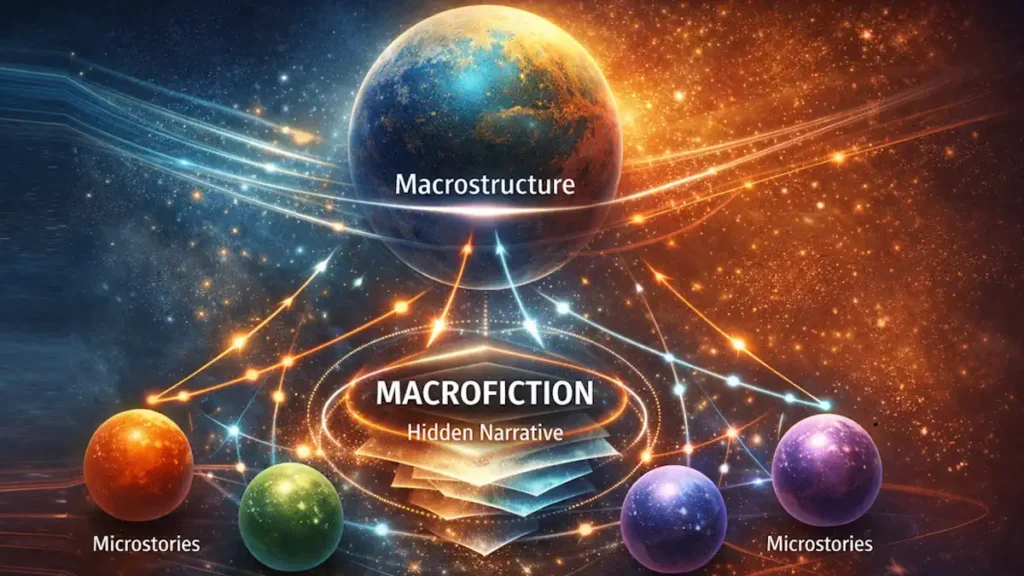
THE MACROFICTION STRUCTURE
ABSTRACT
According to Van Dijk, all phenomena have macro and Microstructures. This paper examines the interaction of these structures, leading to an innovative one: the structure termed Macrofiction. It is a layer of patchy structures, joined together to build an untold story. Separate stories are connected through the cohesive elements they share. Moreover, the cognitive mechanism and information structure of a story on the level of the Microstructure is in harmony with the plot and the general idea of the fiction. This idea is inspired by specimens from classical Persian literature such as “The Conference of the Birds” (1177) and continues well into contemporary literature. This paper demonstrates the nature of macrofiction and the process by which it may be formed in a fictional discourse such as that found in Ebrahim Golestan‘s story cycle, “Hunting the Shadow”.
Macrostructure, Microstructure, Macrofiction, “Hunting The Shadow”, Ebrahim Golestan.
INTRODUCTION
According to Van Dijk, it is possible to interpret or use many phenomena as “wholes” (macrostructure), as cognitive units of some kind, with respect to the various “parts”, “sections” or “elements” (Microstructure) of these whole objects. Thus, macrostructures could be considered a plot, summary or a large-scale statement of the content of a text. If some common schemata cover these both structures, this part-whole relation, in my opinion, will map the macrostructure of the text through some paratextual and cohesive elements on all the texts of stories in the collection, and will create an untold story, a macrofiction (in my terms).
This paper aims to theorize the nature of macrofiction and the process through which it is created and formed in fictional discourse. Likewise it aims to address the manner in which transtextual and discursive elements support the macrofiction, and the manner in which micro and macrostructures are in harmony with each other to create this novel structure.
As for the first issue, macrofiction is considered not only of the idea of holistic structures and their specific properties of different macrostructures, but also a layer of patchy structures joined together by system mapping through some cohesive and transtextual elements to build an untold story in readers’ minds. This untold narrative may be traced in stories such as Ebrahim Golestan’s “Hunting the Shadow” and operates as a layer which links the various and detached structures together by using cohesive and transtextual elements which lead to the formation of a semi-novel. This type of genre contains some detached short stories, called a ‘story cycle’ or ‘novel-in-stories’. In studies carried out in the west, there are many investigations about the reality of ‘story cycle’ subgenre (Mann, 1989; Lundén, 1999; Morris, Ann and Maggie Dunn, 1995), but not those using the linguistic approach, which have at their disposal the method of deep analysis of textual links between stories.
The link between these stories is formed through the adoption of an innovative structure, namely ‘macrofiction’, inferable by the reader. As a result, the fictional works are formed not only on the basis of macro- and Microstructures, but also on the another structure formed by virtue of the interrelation between these two structures, namely ‘macrofiction’. This new formation is created by the correlation between system mappings of different narrations to form an untold story in reader’s minds (Sadeghi, 2012).
LITERATURE REVIEW
The history of sequence stories returns to Joyce’s Dubliners (1914); Sherwood Anderson’s Winesburg, Ohio (1919), Faulkner’s The Unvanquished (1938); Jean Toomer’s Cane (1923), Welty’s The Golden Apples (1947), Hemingway’s In Our Time (1925), etc. (Ferguson, 2003: 1). However, the techniques which link together the stories are dissimilar, so there are some different titles such as ‘cycle story’, ‘sequence story’, ‘novel-in-stories’, ‘cluster story’, ‘composite story’, etc. to call this type of fiction as a novel genre. It is obvious that besides the similarities between some instances of this genre, it would be the differences which elicit a variety of objections for naming them ‘cycle’ or ‘sequence’ or some other term, and for classifying them in different sub-categories.For example, “Winesburg, Ohio”, which is described as series of loosely linked short stories is not, in my opinion, loosely linked; rather, the thread connecting the stories maybe be found and analyzed through structural discursive analysis, since macrofiction renders the stories similar to a novel, in that they feature, for example, a unified topic.
Anderson wrote in his memoirs:
“The stories belonged together. I felt that, taken together, they made something like a novel, a complete story” (Anderson, 1969: 289).
The idea of story cycle has been recently applied to the west, but in modern Persian Literature is not as common as in English. In this kind of short story collection, narratives are composed and arranged with the goal of creating an enhanced or varied experience when reading the group as a whole as opposed to its individual parts (Mann, 1989: 12). There are four types of cycles, listed in decreasing unity of interrelated parts, with different points of view (Lundén’s, 1999: 37-38):
A. The cycle: the ending resolves the conflicts brought up at the beginning.
B. The sequence: each story is linked to the ones before it but without a cumulative story that ties everything together.
C. The cluster: the links between stories are not clear and the discontinuity between them is more significant than their unity.
D. The novella: unrelated stories brought together by a frame story and a narrator(s).
It seems that in Iranian literature one may identify an additional kind of cycle story which is not completely inspired by western types rooted in classic Persian poetry, namely “Conference of the Birds” (Manteq-ol-teyr) (1177). According to the plot of the poem, a group of birds gather to decide who is to be their king. The wisest of them (the hoopoe) suggests that they should find the legendary Simorgh (similar to the Phoenix, whose name in Persian literally denotes ‘thirty birds’). They reached the Simorgh nest and find their reflection on the lake. Every part of this long poem is narrated by a single bird, so the thirty patchy structures (thirty narrated stories by thirty birds) are finally joined to each other and construct a united and superior bird, which is a metaphoric representation of macrofiction.
The genre of contemporary Iranian narratives starts with the oeuvre of Ebrahim Golestan’s works. “Hunting the Shadow” (1955), a story cycle by Golestan, evokes neither a novella nor a cluster story, nor a sequence of character sketches sharing common motifs (as cohesive elements), nor a similar thing like a common place (as a cohesive element), nor a similar topic or narrator. Broadly speaking, it is a collection of stories linked together through a variety of transtextual structural elements such as the title of the book, the title of the stories, the dedication, the opening poem of the book, etc. Although the detached stories do not follow a linear sequence, one can read them as a semi-novel narrated in different points of view with respect to a similar macrostructure in both surface and deep levels of the book.
A TEXT AND ITS INTERPRETIVE STRUCTURES
Micro and macrostructures
According to Van Dijk (1979), interpretation is formulated in terms of an explicit semantics or “more subjective in the sense of a hearer/reader assigning some meaning to a discourse”. Literature, according to Van Dijk, is not only a specific set of discourses, defined on the basis of specific textual properties, but also a type or mode of communication or speech act, aiming to reflect the social conditions, functions and effects of such acts in the communicative context of writers, readers, reviewers, etc. (Van Dijk, 1979: 143). Let us define ‘literariness’, i.e. the literary quality of the text, in terms of literary discourse structures and the role of such “discourses in progresses of socio-cultural interaction”, traditionally called literary interpretation. The reader gradually constructs a semantic or conceptual representation of a text in his/her memory, so the story is understood and represented in the reader’s mind. What is generally stored in the long memory is the macrostructure of a story, as Van Dijk believed. As soon as one understands a text through its Microstructure, he/she “no longer needs the surface structure of information”.
Consequently, the general concept of the information stored in the long-term memory through reading is retrieved by means of coherence elements. However, “a sentence interpreted as a sequence of propositions is stored in long memory” as soon as following sentences have to be interpreted (Ibid: 146). In other words, the sentences of a text are linked to each other through associative lexical elements.
To complete the theory of macrostructure (entitled macrorules, which entail knowledge of the world), cognitive tools are introduced as ‘frames’ or ‘scripts’ (Schank & Abelson, 1977: 40). A macrostructure consists of numerous macropropositions, such that the whole macrostructure is organized hierarchically (see figure 1), with each sequence of macropropositions subsumed under a higher level of macroproposition (Van Dijk, 1986: 32).
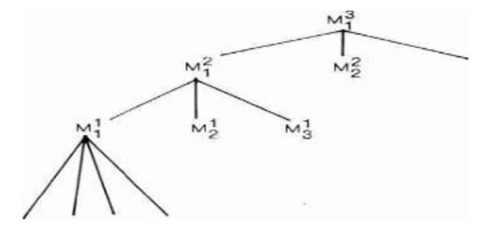
Figure 1. Schematic representation of the semantic macrostructure of a text (Van Dijk, 1986: 33).
These hierarchical connections can be formulated by macrorules which could delete, generate and construct elements of information from the propositions in order to render them more abstract, covering the whole text. This hierarchical structuring may also represent what one naturally understands by summarizing. Macrorules are semantic mapping rules or transformations, which link lower-level propositions (figure 1, M 1) with higher level macropropositions (figure 1, M 3). To wit, topics or themes are derived from the meanings of a text by such summarizing macrorules. These rules outline the “upshot, gist, most important information, and hence the theme or topic for each sequence of propositions of a text”.
There are three different rules for reduction, namely: deletion, generalization, and construction, which may be repeated as often as possible in order to represent the “three major macrorules that reduce information of a text to its topics” (Ibid: 32). They are recursive rules which could be repeated as much as a possible to represent the main schema of the text.
A. Deletion rules: At the first initial stage, deleting “all information that is no longer relevant in the rest of the text, such as local details”.
B. Generalization rules: Replacing a sequence of propositions by one generalization.
C. Construction rules: At the final stage, replacing “a sequence of propositions that denote the usual event as episode by one macroproposition that denotes the act or event as a whole” (Ibid: 34).
It is possible to summarize a novel by these macrorules recursively to get a few macropropositions and finally at the highest level, where one or two macropropositions resume the text as a whole to get the main macrostructure as the schema or frame of the story. “The topics guarantee the coherence of a text, as if they are properties in or of the meaning of a text”. Meanings are assigned to the texts in the processes of interpretation by the readers. The same is true for macrostructures. Readers assign a topic to a text, or infer it from a text, and these processes are a constituent part of understanding (Ibid: 33).
The reader predicts “the most probable topic(s) of a text, aided by the thematic signals” of the text (Van Dijk, 1986: 34). As soon as the reader has heard a first sentence of a story, he/she may try to guess what the whole topic of the story may be. At the end of the story, he/she may grasp that all the sentences of the story were covered by the general topic systematically and thematically. Once the reader perceived the topic, it is easier to follow the subsequent sentences of the story. As a result, the relation between the topic of the story and its structure are able to weave a cohesive text for the story. The interaction between the topic of each sentence and the work in to, as well as between the structure of a story and a book in to, has potential of leading to a new, innovative structure, also termed macrofiction (as I see it).
Macrofiction and Mappings
In the present paper, working on Ebrahim Golestan’s short story collection as a story cycle aims at identifying the process by which the interrelation between micro and macrostructures leads to structuring macrofiction, as it may be recognized in some types of cycle stories. If “a literary work composed of shorter texts that—though individually complete and autonomous—are interrelated in a coherent whole according to one or more organizing principles” (Maggie Dunn and Ann Morris, 1995: xiii), then the tool of macrofiction (as I termed it) creates a type of story cycle through transtextuality (to use a term coined Genette 1992),
“[F]or the moment the text interests me (only) in its textual transcendence – namely, everything that brings it into relation (manifest or hidden) with other texts. I call that transtextuality” (Genette, 1992: 81).
The interaction between micro and macrostructures creates macrofiction partly through transtextual elements and partly through cohesive items. The reader may find several interpretive traces in the text through the relation between a variety of texts (each part of a book, such as title, preface, etc. is considered a text) and end the sentence with existing between and within the texts. In other words, macrofiction not only covers the holistic structures and their properties, but also considers a layer of detached structures joined together by virtue of a variety of cohesive, transtextual materials to create an untold story.
Macrofiction is created through the form and structure of the cycle story and all the stories have the structural features which make them seem independently meaningful even in isolation from the others. It is worth mentioning that the role of readers is very central for structuring macrofiction in the mind; that is, what readers do through reading and interpretation, namely, constructing the relations of parts to wholes. According to Robert Luscher (1989),
“A volume of stories collected and organized by their author, in which the reader successively realizes underlying patterns of coherence by continual modifications of his perceptions of pattern and theme […]. The volume as a whole becomes an open book, inviting the reader to construct a network of associations that binds the stories together and lends them cumulative thematic impact” (Luscher, 1989: 148).
There should be some transtextual elements which make this cumulative thematic impact, beyond the ‘cluster’, ‘sequence’ or other above-mentioned types of story cycle. So the result of the operation of transtextual elements is making a larger story leads to macrofiction in this paper. It is a general term for the method resulting in thematic unity represented at the macro and micro level as well. The holistic and cohesive structure of theses interrelated stories ought to be recoverable through a variety of transtextual elements in systematic method, and ought to “share some principle of unification that gives structure, movement, and thematic development to the whole” (Nagel, 2001; Ferguson, 2003: 3). The most typically used technique is shared setting, character and theme.
By and large, there are numerous ways to unify the story cycle in terms of various types of transtextual elements which Genette (1992) introduced as five sub-categories: intertextuality, paratextuality, metatextuality, hypertextuality and architextuality. He admits that the five types of transtextuality cannot be entirely separated from each other, because of their reciprocal relationship or inevitable overlapping.
Genette’s concept of intertextuality is condensed to “a relationship of co-presence between two texts or among several texts” as “the actual presence of one text within another” (Genette 1992: 1-2). Thus intertextuality could result in shared theme and motif. Paratextuality marks the elements at the opening of the text, and helps to manage the reception of a text by its readers. This threshold consists of peritext (within the book) and epitext (outside the book). Peritext has a major effect on the interpretation of a text and on the creation of macrofiction: it includes a cover, title and subtitles, pseudonyms, epigraphs, prefaces, intertitles, epilogues, front matter (dedication, opening information, foreword), back matter (endpapers, colophon) footnotes, formatting or typography, chapter titles, captions and notes, illustrations and many other materials.
What is more, Metatextuality denotes explicit or implicit references of one text on another text. “It unites a given text to another, of which it speaks without necessarily citing it” (Genette 1997a: 4). Obvious references express all details in a clear way, leaving no doubt as to the intended meaning. Implicit, not stated references, understood in what is expressed may also be active in the creation of macrofiction.
Hypertextuality involves “any relationship uniting a text B (which I shall call hypertext) to an earlier text A (I shall, of course, call it the hypotext), upon which it is grafted in a manner that is not that of commentary” (Ibid: 5). Thus, hypertextuality represents the relation between a text and a text on which it is based. Hypertextuality clearly results in macrofiction in the readers’ mind. Finally, architextuality is “the relationship of inclusion linking each text to the various kinds of discourse of which it is a representative”. The architextual nature of texts also includes thematic and figurative expectations about texts. “The reader’s expectations, and thus their reception of the work” is a very important factor of this type (Genette Ibid: 5).
Concentrating on the structure, the order of the stories, and unifying elements (such as themes, characters, point of view, setting, internal symbolism, place, voices, language and events, a number of transtextual elements (such as the title of a book, the title of each story, chapters and inter-chapters, the semantic relation of the stories and their inter-relation, the relation of each story with other texts) serve to interrelate the different structures of detached stories to create a macrofiction.
“Hunting the Shadow” and “December, the Last month of autumn” are two works of Ebrahim Golestan in which macrofiction through transtextual elements connect the detached stories to each other. In fact, in reading these two works and interpreting them, the active reader plays an important role. The stories in “Hunting the Shadow” do not interlink like Sherwood Anderson’s Winesburg, Ohio (1919) with a common property (Place) or Hemingway’s In Our Time (1925) with a rance of related topics like love, marriage, divorce or friendship. It goes beyond having a shared property or themes; that is, it is a story book in which macrostructure of a paratextual text is mapped onto to all the stories of the collection and creates an untold story as macrofiction.
The Analysis of Shadow Hunting
In the opening of “Hunting the Shadow” (1955), a poem is quoted as a peritext, which includes couplets from Masnavi Manavi by Molavi (13 th C. Persian poet). This peritextual poem is considered a cohesive link between the title of the collection and the titles, themes and schema of a number of sentences in the microstructure of four stories inside the book. In other words, the title of the work is inspired by these couplets which act as a key element to link the stories to one another.
It is flying on the high, the bird
While its shade is flying fowl-like on the earth,
A fool is going to hunt the shade,
Being tired of running after the shadow he chased
Shooting, at the shadow, arrow upon arrow
From shadow hunting, his quiver goes hollow
His life faded, the quiver of his life become waste,
As running in hot to hunt the shade
If the macrostructure of these couplets is recognized, the macropropositions of each part in the first level may map onto the next level (see. figure 1). According to the poem, a bird is flying in the sky. Its shadow appears on the earth. A fool starts shooting at the shadow. His quiver became empty with no access to anything. The quiver is like life (metaphor). The quiver becomes empty (metaphoric mapping). Emptiness is nothingness (metaphoric mapping). Life is empty.
Life is nothing.
According to Fauconnier (1997), blending could operate on more than one domain or space and inherits partial structure from the input spaces and has emergent structure of its own. It works on two Input mental spaces to yield a third space, the blend (Fauconnier, 1997: 11). The blending of key elements of the poem leads to a new composite, constructed through metaphor, a concept mapped onto the already existing structures of a story, such as its titles or narratives. Following figure shows how the blending occurs in the key elements of the poem,
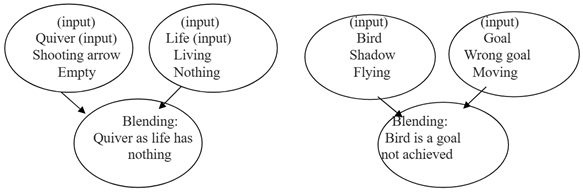
Figure 2. Blending in the opening poem of the book.
The macroproposition of the poem is mapped onto the title of the book, based on a schema “life is nothing”. The title and the poem seem to have a shared macrostructure, as is suggested by the semantic and structural relations between them. Macrofiction is created through the mapping of one macrostructure (life is nothing) onto another macrostructure, thus forming a system mapping; this last being a one-to-one mapping along structural consistency (Holyoak & Thagard, 1995: 31).
The main schema of the poem is mapped onto all the parts of the stories as their schemata. For instance, “hunting the shadow is nothing” becomes the motif of all stories, and affects the choice of lexemes in every sentence. In other words, the peritexts (title, opening poem, titles of the four stories) are mapped onto the text (Microstructure) of the stories, creating an implicit thematic link through transtextual elements (macrofiction).
The topic of the poem is “a fool tries to hunt the shadow of a bird”, conveying the notion of a waste of time. This topic is mapped schematically onto the topic of four stories: “A foolish person tries to do something absurd”. In the last lines, the metaphoric mapping of “shooting at a wrong goal” is mapped onto the final point of each story: the character of the story chooses the wrong goal, so the macrofiction expresses the notion that all the characters choose wrong goals; since they have paved wrong path, their lives are absurd. As a result, they have wasted their time by absurd actions. In fact, their “life is nothing” is the macrostructure of the work and is achieved through metonymic and metaphorical mappings related to the content of being empty, such as: being empty is nothingness, being empty is being useless, being empty is lacking something, being empty is feeling absurd, etc.
In the first story , for instance, there are some contents with the same schema, such as unknowing something or someone, non-fulfillment of a dream, sadness and so on, which all associate with the metaphoric schemata “happiness is fullness”, “sadness is emptiness”, “fullness is being advantageous”, “emptiness is being absurd”, etc. These schemata, entirely, are represented in their entirety in five main episodes of the first story, dividing the stories into two main schemata: “fulfillment of dream” and “non-fulfillment of a dream”.
Four stories of this story cycle are linked through a macrostructure of book title, “Hunting the Shadow”, as well as the opening poem about hunting a shadow. It is worth mentioning that the active role of the reader builds the links which generate the shared proposition which structures a common theme for all stories.
In the first story, titled “a stranger who’d gone to watch”, there are two paratexts: the title of the story and its acknowledgment to that to Jalal Ale Ahmad (a writer). “Gone to watch” is the predicate of a proposition which has two topics: “stranger” and “a watched thing”. One may infer from this proposition that there is a watchable thing which a stranger goes to watch. However, as the watcher is a stranger, the watched thing is strange to him, so the watcher may achieve nothing. The macrostructure of the story implies that “all the actions of the stranger are nothing”, just as expressed in the title of the book and the in the opening poem.
Life is nothing
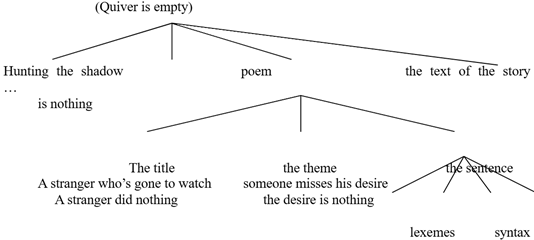
Figure 3. Schematic representation of the semantic macrostructure of “Hunting the Shadow”.
This story is a narrative about an American journalist, Patt, who has appeared in a dream of revolution and renovation in order to join the ‘city of rebellion’, and has yet to see his life’s dream in a state of awareness. Having turned desperate from his dream, finally he ends up in a café and, with a bedfellow, makes night out of day. The failure to achieve anything apparently valuable leads missing several days of one’s life. The same logic may be identified in the macrostructure with its metaphoric schemata, mapped onto the totality of the story: “someone misses something/his desire”. “That thing/desire is not valuable”, so “someone has done a meaningless act to take that invaluable thing/desire”.
The theme which is common to the stories is narrated through diverse Microstructures. However, every sentence on the micro level has the same schema as well (see table 1, appendix). It seems the macrostructure of all the stories is identical. Since the title of the story has the same macrostructure, an untold story, conveyed using similar macrostructures, has certainly been created in order to be read by the readers. The semantic elements which caused this link between micro and macrostructures are possibly expressed by lexemes which play a role in the conceptual domain of signified macrostructure, schemata or various structures throughout the story.
Among the five episodes of the first story, three involve a macroschema implying “non- fulfillment of the dream”, and the other two refer specifically to “fulfillment of the dream”. The story starts and ends with the macroschema of “fulfillment of the dream”. Since the macrostructure of the story as a whole pivots on the central axis of the “dream fulfillment” scheme—and the story starts and ends with this macroschema—both episodes representing “fulfillment construct a dream”, a desire or something of value which the three other episodes deconstruct. In other words, the macrosemantic structure of the story is mapped onto the microsemantic structure in a way that all the lexemes whether attributed to the domain of “fulfillment of the dream” or “non-fulfillment of the dream” to build the theme of the story. The first line of the story is as following:
As soon as the girl uttered ‘hey!’ he was emerged from a gloom-wrapped scantly visible view. This failure to fulfill a seemingly valuable aspiration leads to loss of days upon days from his life (Golestan, 1955: 9).
Mapping of the macrostructure of the book onto the Microstructure is obvious from the first sentence of the first story, in terms of lexical arrangement of “a gloom-wrapped scantly visible view” 1 , which shed some light on the following readings. The main character is unhappy due to missing his desire to join the ‘revolutionary city’. He feels a gloom (sadness and darkness). He attempts to forget the gloomy missed event, but it is difficult and forgetting is scantly visible view, since it relates to the missed desire and non-fulfillment of his essential dream of life; the same thing that he wants to watch – in the title of the story- as a glorious event, evolution, innovative creation, etc.- and in the text of the story. The metaphors of “sadness is missing something” or “sadness is emptiness” are macroschemata, leading hierarchically to another macroschema, “non-fulfillment of the dream is sadness/nothingness”.
Assured uncared movement of the waiters, he saw that the girl crunched her eyebrows into a perplexed mien, staring at him, and then he said: If you didn’t know what it meant and you wanted to show what it meant, then would you have said what it meant?’ (Golestan, 1955: 9)
The expressions Assured and uncared in the text are paradoxically interrelated: uncared stepping is not concomitant with Assured steps, but antithetical to it. Hence, the proximity of these two adverbial expressions creates a sharp effect of irregularity or mismatch. Since the mismatching does not produce desirable outcome, and prevents the subject from attaining beneficial results, this mismatch signifies a lack or absence.
Consequently the macrostructure of the story (non-fulfillment of the dream) not only matches the theme of the title of both story and book, but also is represented in all the sentences on micro level. For instance, the paradox created by the expressions uncared and assured suggests quite overtly a sense of absence, nothingness and emptiness.
Some elements on the micro level are simply used for building a setting, while other, central element (which comprise the heart of story) are achieved through rules of deletion and generation for turning the Microstructures into macrostructure. It is worth mentioning that excluding the main schema of each sentence leads to the main propositions in the story conceived through inference.
In the second sentence, the arrangement of “’If you didn’t know what it meant and you wanted to show what it meant” represents the macrostructure of being or feeling absurd and the lexemes semantically refer to nothingness (in Microstructure) as well, since not knowing is a kind of lack or emptiness which metaphorically means being useless or absurd.
Generally the episode of “fulfillment of the dream” has two schemata, including “fulfillment of the dream is happiness” and “happiness is advantageous”, represented in the Microstructure of the story. However, the other three episodes deconstruct these two, because the character cannot achieve his goal, so he spends his time absurd way.
“A young man in a pale pelt cap which he had bought for himself en route to Beirut was smiling joyfully. He was approaching the capital of this country and there he could see close at hand what he wants to see” (Golestan, 1955: 14).
In the sentence where Patt buys a plane ticket, the following emotions and motivations are described relating to him: he desires to join the ‘revolutionary city, he likes ‘moments of today were to him tidings of glorious tomorrow’, he thinks people ‘are in the threshold of the majesty of change’, the narrator relates his ‘hilarity of certain and vivacious waiting’, and that ‘he was happy and pleased’, ‘The memory of last night lustfully pleased him’, ‘He knew he would see in reality the dream of his life’ and so on, all are some sentences of the first story with the schema of “fulfillment of dream is happiness”, “non-fulfillment of dream is sadness”, “happiness is advantageous”, “sadness is absurd”.
Patt and Ninotchka, for instance, are waiting for the waitress to fill the empty plate with soup. The expressions empty plate or filled plate symbolically represents the theme underlying the whole story. However, Patt is not interested in eating the soup with which the plate was filled, a tableau which is symbolically (mapping the theme of sadness onto all the sentences) deconstructed from “happiness is advantageous” to the opposing schema, “sadness is absurd”. Consequently, it could be inferred that the friendship of Patt and Nina in terms of forgetting the “non-fulfillment of a dream” is a representation of “sadness is absurd”, since Patt ignores the girl in an unfriendly manner after going to bed with her—precisely due to non-fulfillment of his dream by Nina (he realized that). Therefore “Hunting the shadow” as “non-fulfillment of a dream” is considered the theme of “The stranger who goes to watch” as well as the theme of “High noon in hot July”.
The plot of the second story, ‘high noon in hot July’ revolves around the actions of a man who, on a hot summer noon carries a fridge for delivery. He is looking for an address which turns out to be incorrect, but which he assumes is in fact correct. This results in the goods not arriving at their destination. The Macrostructure of this story is like the previous one, “Emptiness is being absurd”; that is, the man does not arrive at his goal or he is empty (like a dish) from arriving to his purpose (like a path).
The title of the story emphasizes hot whether intensively through three lexemes: noon, hot and July (a symbol of the hot season in the reader’s presupposition). All three elements emphasize the scorching air as an obstacle for carrying out an action. This hyperbolic high temperature associates the tiredness of a given act and the absurd action which the man insists on doing without thinking about his wrong goal. Thus “emptiness is absurd” is mapped from the entrance of the book (Molavi’s poem) onto the title of the story and then its propositions in terms of reader’s presupposition and the context of the story. Mapping of this schema is realized from the first sentence of the story to the end:
“The man was listening to the sound of the parched wheels of the chariot as they clattered with an inexorable, heated self-propelled force on the cobblestones under the dark sun” (Golestan, 1955: 34).
The summary of Microstructure of “listening to the sound of the parch wheels of the chariot as they clattered with an inexorable, heated self-propelled force on the cobblestone under the dark sun” is ‘listening to the sound of tired wheels that a tired person pushed.’ It signifies the difficulty of the movement of the wheels. Since the wheels in the beginning of the story move uneasily, expectation of the wheels reaching the end point seems an absurd expectation. The continuation of the story supportes this idea through the lexical arrangement which represents the macrostructure of “Emptiness is being absurd”.
“Perhaps he should stand still a bit, so the heat will ease, and someone, anyone, may turn up who could provide the address. There must be someone; there must be people who know where the load needs to be delivered. He either misunderstood, or he was wrongly informed, and now, in this godforsaken hellish back alley he has no access to any of them. Then, a man got out of a taxi with a woman, whose back, in its flowery dress, was in motion; her legs were naked. She said:’aint no infernal verses raining down on us like fire and brimstone in this heat?” (Golestan, 1955: 44)
At the end of the story, again the same macrostructure, “emptiness is absurd” is used after the schema “not knowing is emptiness” which is excluded from the sentence “and someone, anyone, may turn up who could provide the address”.
The plot of the third story, ‘The lame man’ tells the tale of an individual named Hassan whose job was to carry a lame man on his back. With the passage of time, he acquires a wheelchair and thus the porter no longer has any work, so he breaks the wheel with the aim of being needed again. The macrostructure of this story is “someone misses something meaninglessly”, which is near to the other stories’ macrostructure.
Likewise in the last story ‘A man who fell’, a house painter fell from the ladder, and for a while rested at home. During this time, out of indolence he avoided doing any work and eventually lost his life and existence as he knew it.
As shown, all the stories occur in different settings and different characters, but a similar macrostructure links all of them to each other hierarchically and composes a larger untold story about a human being who spends his life absurdly in different situations and times.
Based on the mechanism and analytical tool of macrofiction, characters of this larger story follow the shadow of their goals, not the original ones. They follow the result (shadow) not the object. In the final analysis nobody can access the shadow, because hunting the shadow is fundamentally wrong purpose. Mapping of the theme is done from peritexts of the book like titles, opening poem, the acknowledgment and other transtextual elements onto the story text, so all the higher levels are mapped onto the lower levels (Microstructure) hierarchically and this mapping creates macrofiction in the readers’ mind.
CONCLUSION
This paper aims to theorize the nature of macrofiction and the way it is created in fictional discourse. Macrofiction not only is the idea of holistic structures and the specific properties of different macrostructures, but also a layer of patchy structures joined together by system mapping through some cohesive and transtextual elements to build an untold story in the readers’ mind. To study how transtextual and discursive elements support macrofiction, “Hunting the Shadow”, a work by Ebrahim Golestan is analyzed. Then follow the presentation of how macrofiction operates as a connecting layer which links the detached stories together through using shared macrostructure and in the next step mapping this macrostructure as higher a level onto the lower levels of the text.
The interaction of micro and macrostructure may be shown as a mapping of a schema from the macrostructure onto the Microstructure to build a system in a story cycle, in which the role of reader is very important. Consequently, the story takes place not only in micro or macrostructure, rather there is another structure which makes the links between different structures and makes a united narrative in the reader’s mind.
International Journal of English Language and Linguistics Research
Vol.1, No.2, pp.13-30, September 2013
European Centre for Research Training and Development UK
Leila Sadeghi Esfehani Linguistics, university of Tehran