
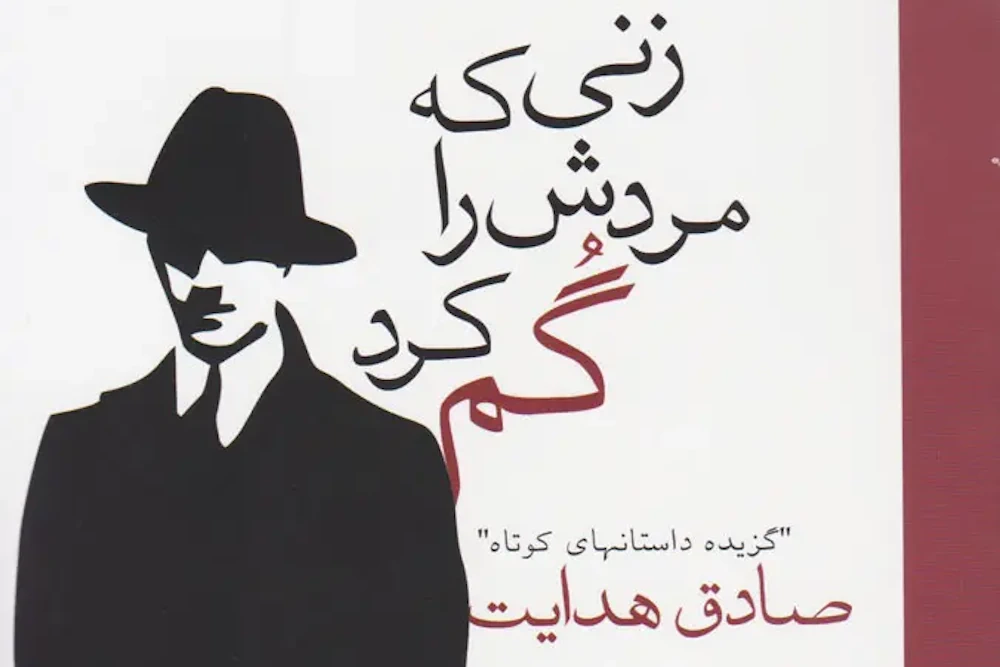
“Why are you going to Mazandaran?”
“To find my husband.”
“Is he lost?”
“He left me without a penny a month ago.”
“How do you know he’s there?”
“Kol Gholam, his friend, told me.”
“If your man has that much pride, he’ll run from there too. How much money do you have?”
“Two tomans and two thousand.”
“What’s your name?”
“Zarin Kolah.”
“Where are you from?”
“From Alviz, Shahriar.”
“Instead of going to look for your husband, go back to Shahriar. It’s grape season now. Go to your relatives and eat grapes. Why wander off to Mazandaran? You’ll die a stranger there, with that absent mind of yours!”
“I must go.”
Zarin Kolah said this with complete certainty, as if her decision could not be changed. Her dull eyes stared ahead without seeing anything. She seemed to speak without will or thought, her mind elsewhere.
The constable turned to the driver.
“Sir, drop this woman at Darvazeh Dowlat and show her the way.”
Encouraged, Zarin Kolah said, “I’m a stranger. Please show me the road. God will reward you.”
The car started. Zarin Kolah sat motionless, staring ahead like a beaten dog. She had large black eyes, thin arched brows, a small nose, fleshy lips, hollow cheeks. Her skin was fresh and wheat-colored. All the way she swayed with the motion of the car, unaware of anyone.
Her child lay quiet and sad in her arms, dozing, holding a pomegranate sweet.
Near Darvazeh Dowlat, the driver stopped and pointed out the road toward Darvazeh Shemiran. She got down and set off immediately along the long sunlit road, child in her arms, bundle in hand.
At Darvazeh Shemiran she entered a garage. After half an hour of bargaining, the owner agreed to take her as far as “Asiasar” on the Sari road, charging her six rials. She was squeezed into a large truck crowded with passengers and bundles. They shifted to make space for her.
The truck was filled with fuel, honked, spread the smell of gasoline and burnt oil, and rolled onto the dusty road.
At first the landscape was flat, then hills, mountains, distant trees, winding roads. Zarin Kolah stared ahead with the same faded look.
They were stopped several times to inspect travel permits. Near noon a wheel broke in Shelambé and some passengers got out. Zarin Kolah stayed seated, afraid of losing her place. She opened her cloth bundle, took out bread and cheese, gave a piece to her son, and ate a few bites herself. The child was silent as an opium-drowsed sparrow.
Hours passed. They went through Jaban and Firuzkuh. Beautiful forests appeared. But she watched everything with indifference.
Yet inside her a hidden joy grew. Her heart beat faster. She breathed more freely. She was nearing her destination. Tomorrow she might find Gol Babu.
What would his house be like? His relatives? How would he treat her after a month apart? What would she say?
She knew she would say nothing. In his presence her tongue would go numb. He possessed a force that nullified her will. She would become entirely subject to him.
She knew he would threaten her. Then the whip—the same whip he used on his donkeys—would fall on her back.
And that was precisely why she was going. She longed for that whip.
Two years earlier she had married Gol Babu. She first saw him during grape harvest. He was from Mazandaran, strong, bold, with red lips, blond hair, thick neck, powerful arms. He sang as he worked, correcting the girls’ pronunciation of a Mazandarani song:
Galash kori ah hay lele,
Bushim bejar ah hay lele…
It wasn’t just his song that captivated the girls, especially Zarin Kolah. It was his daring. His body. His glances. She was only fourteen.
That night she couldn’t sleep. Under the moonlight, by the courtyard pool, she wept. Her whole body seemed made to be held by him. Better to rot in the ground than waste her life in her mother’s house with curses and misery.
She vowed: if she married Gol Babu, she would free a pigeon and light a candle at the shrine.
Within days arrangements were made. Despite her mother’s curses—“May your wedding turn to mourning!”—she married him. There was music, collected coins, laughter.
She left her father’s house gladly.
In Tehran, for two months, they were happy in a small room near Sar-Cheshmeh. Then, in the third month, Gol Babu changed. He spent nights in the coffeehouse smoking opium with Kol Gholam. He gave her no money.
And he whipped her.
For small things: burnt cloth, salty stew, late samovar. He would whirl the black leather whip with two knots and strike her arms, thighs, back.
She cried loudly. Neighbors intervened. He kicked her aside. Later, at night, they reconciled. He kissed her tear-wet eyes. They ate together from the same bowl.
This repeated every night.
She writhed under the whip—but secretly she enjoyed it. The more he beat her, the more she loved him. His smell of stable and sweat, his rough body, his red cheeks and thick beard—these were beautiful to her.
Nine months later she bore a son. Two red marks crossed the child’s back like whip scars. She believed they had passed from her to him.
Business worsened. One donkey died; another was sold. He left, saying he would return in twenty days. A month passed. More days.
She searched everywhere. Finally Kol Gholam told her: “Babu? He’s gone back to his village, Zarinabad. Told me not to tell anyone.”
So she sold her brass samovar and copper pot. Paid her debts. Packed bread and cheese. Got a permit.
And now she had arrived.
In Zarinabad she found his house. An old woman answered.
“I’m Gol Babu’s wife. I’ve come from Tehran. This is his son.”
“Gol Babu divorced that woman. This child is a bastard.”
Gol Babu appeared, shirt open, another thin yellow woman clinging to him.
“Babu jan! I’ve come!”
“Go away. I don’t know you.”
The old woman cursed her. Gol Babu looked at her with contempt.
She understood.
She placed her child at a doorway and told him, “Sit here, dear. I’ll come back.”
She did not return.
She felt lighter without him. Without money. Without bundle. Free.
At the edge of the village, a young man with a whip rode by, leading two donkeys.
“Sir, have mercy. I’m a stranger. Let me ride.”
He stopped. Lifted her onto a donkey. Did not look at her face.
He whirled his whip and struck the donkey. The bells jingled. As they passed a barley field, he whistled a tune.
It was the same tune Gol Babu had sung in the vineyard:
Galash kori ah hay lele…
Zarin Kolah thought:
“Perhaps this one, too, has a habit of whipping… and smells of donkey and stable.”